

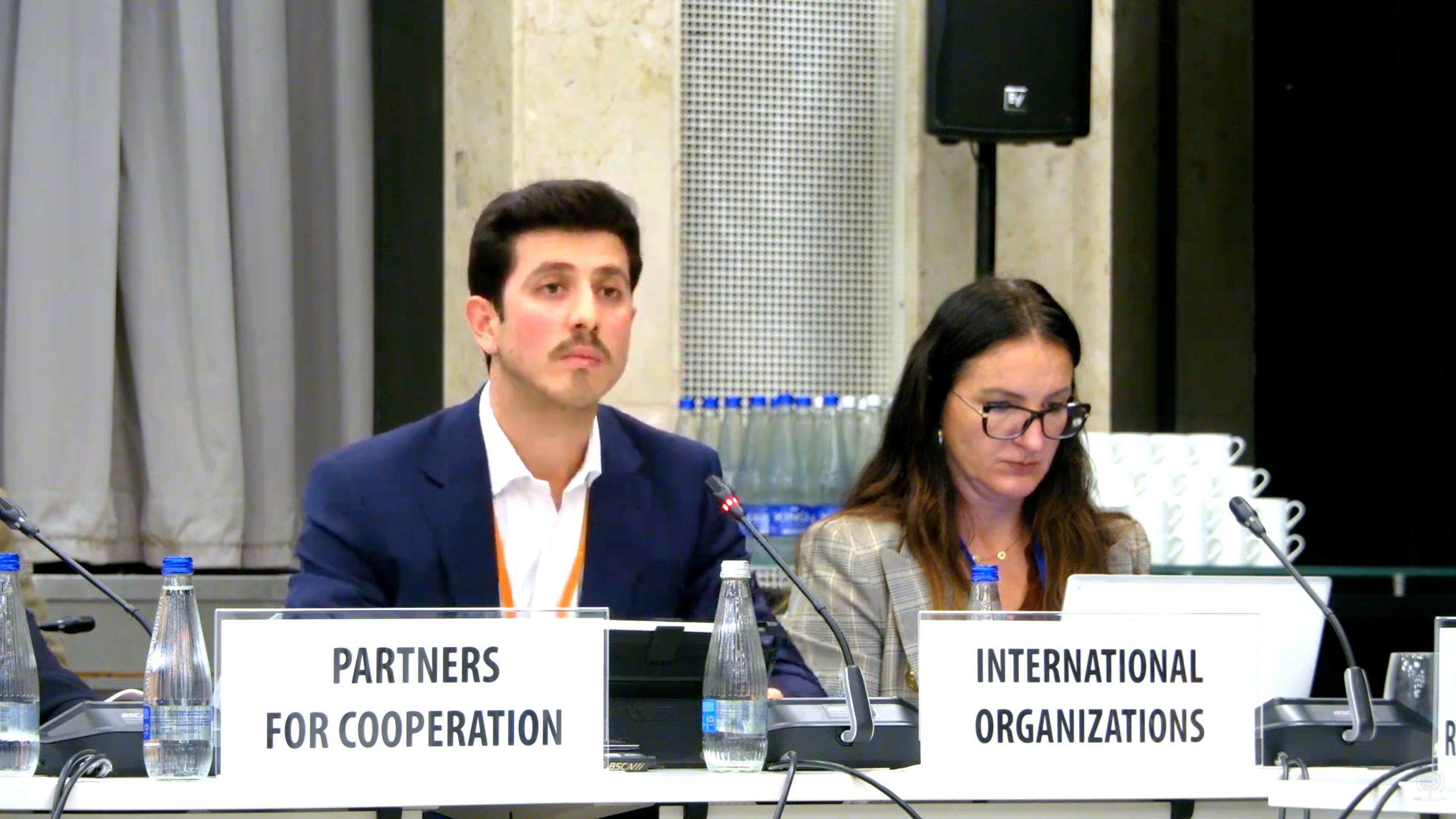
World Human Rights Defender (WHRD) took the floor at the 2026 Warsaw Human Dimension Conference, presenting the international community with three key messages and three concrete recommendations on armed conflict, states of emergency, and the human rights obligations of States.
Speaking on behalf of WHRD at the conference was Kadir Noyan, lawyer and human rights activist.
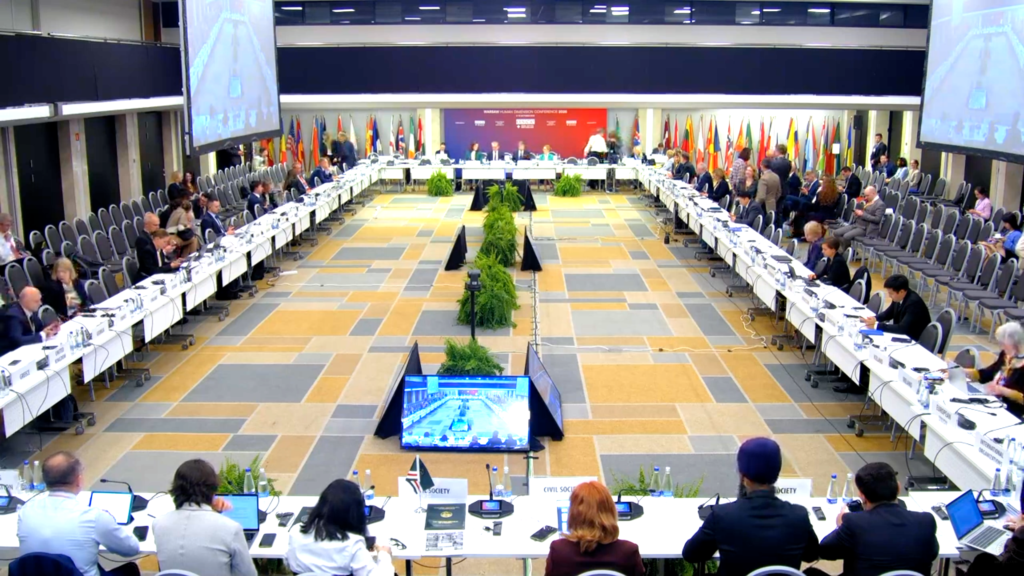
The 2026 Warsaw Human Dimension Conference, held in Warsaw from 5 to 15 October 2026, brings together representatives of States, international organisations, and civil society to review the implementation of human dimension commitments across the OSCE region and to discuss human rights, the rule of law, democratic institutions, and fundamental freedoms.
The central message delivered by Kadir Noyan on behalf of WHRD was clear:
“Human rights law does not fall silent when the guns speak.”
Armed conflict does not suspend human rights law
Kadir Noyan emphasised that armed conflict does not bring States’ human rights obligations to an end.
Referring to the jurisprudence of the International Court of Justice from 1996 and 2004, the European Court of Human Rights judgment in Hassan v. the United Kingdom, and the Grand Chamber’s 2025 judgment in Ukraine and the Netherlands v. Russia, WHRD stressed that international human rights law continues to apply during armed conflict, while international humanitarian law informs its application.
The OSCE Code of Conduct on Politico-Military Aspects of Security likewise requires participating States to ensure that their armed forces operate consistently with international law and international humanitarian law.
The normative framework exists. The real challenge is its consistent application.
A state of emergency must not become a permanent form of governance
The second central issue raised by WHRD was the danger that exceptional powers introduced during periods of crisis may gradually become instruments of ordinary governance.
The OSCE’s 1991 Moscow Document requires emergency measures to remain strictly limited to the exigencies of the situation and the state of emergency to be lifted as soon as possible.
In his intervention, Kadir Noyan referred to Türkiye as an important example of the long-term consequences of emergency measures.
Although the state of emergency and Türkiye’s derogations from the European Convention on Human Rights ended in 2018, many of the legal and human consequences of measures adopted during that period continue today.
Well over 100,000 public officials were dismissed, and cases arising from these dismissals continue to reach national and international courts.
In particular, in Yüksel Yalçınkaya v. Türkiye, the Grand Chamber of the European Court of Human Rights identified a systemic problem concerning convictions based on the domestic courts’ approach to the use of ByLock. Thousands of similar applications remain before the Court.
WHRD therefore underlined a fundamental principle:
Exceptional powers must not become ordinary instruments of governance.
Accountability must not be selective
The third part of the intervention called for the consistent and universal application of international legal standards.
Kadir Noyan stated that WHRD considers the mobilisation of OSCE mechanisms in response to Russia’s aggression against Ukraine and serious violations of human rights and international humanitarian law to be important.
At the same time, the same legal standards must guide scrutiny of the cross-border military operations of every OSCE participating State.
In this context, WHRD called for Türkiye’s military operations in northern Syria and Iraq also to be scrutinised consistently under international human rights law and international humanitarian law.
WHRD expressly clarified:
This does not mean equating different conflicts or their respective legal character.
It means that international law must not depend on which State is acting or on the prevailing political circumstances.
Human rights and international humanitarian law obligations are universal. Selective application weakens the law. Ultimately, it also weakens the credibility of the OSCE’s own human rights framework.
Three concrete recommendations from WHRD
Kadir Noyan presented three concrete recommendations on behalf of WHRD:
1. To OSCE participating States:
Derogations from human rights obligations must be notified transparently, legally justified, and strictly time-limited. When the emergency ends, exceptional measures must also be dismantled.
2. To Türkiye:
The judgments of the European Court of Human Rights in Yalçınkaya, Kavala and Demirtaş must be fully implemented. Obligations arising under Article 46 of the European Convention on Human Rights are not a matter of political discretion but binding obligations under international law.
3. To the OSCE Office for Democratic Institutions and Human Rights (ODIHR):
ODIHR should use its mandate and expertise concerning states of emergency and derogations to systematically monitor and report on emergency measures across the entire OSCE region.
Human rights law is tested precisely in times of crisis
Kadir Noyan concluded his intervention on behalf of WHRD with a fundamental principle:
“Human rights law is tested not in normal times, but precisely when States say that normal rules can no longer apply.”
The true test of human rights law does not come in ordinary times. It comes precisely when States argue that ordinary rules can no longer apply.
WHRD will continue to advocate for the consistent application of international human rights law and against its selective application under the pretext of war, security, counter-terrorism, or states of emergency.
The universality of law is meaningful only if it can be upheld precisely when circumstances are at their most difficult.