

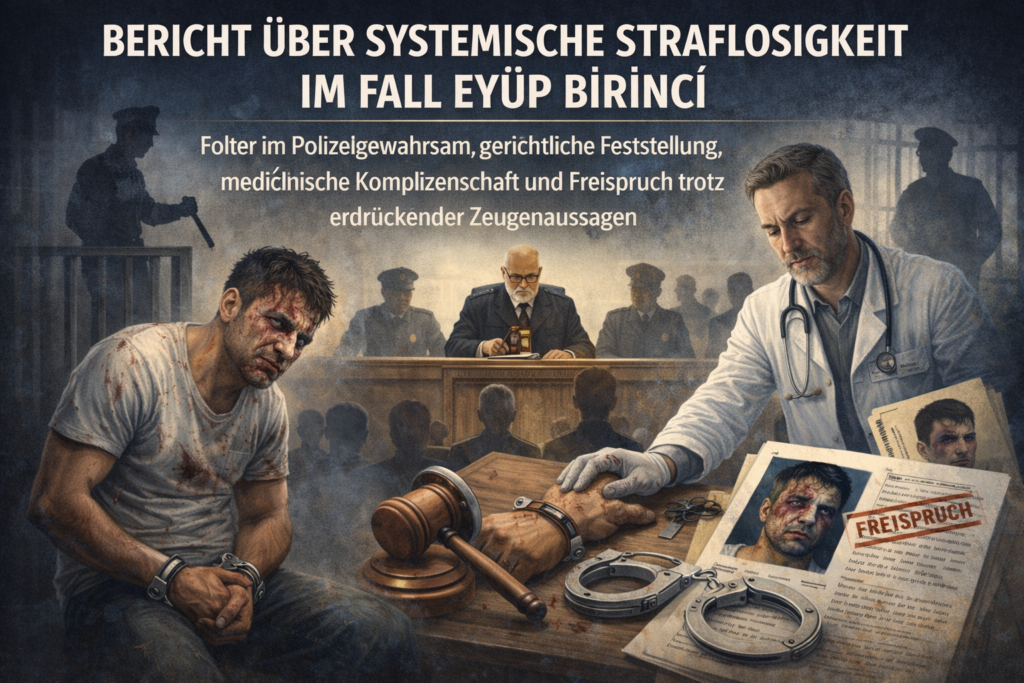
Torture in Police Custody, Judicial Determination, Medical Complicity, and Acquittal Despite Overwhelming Witness Testimony
Context after July 15: Allegations of Torture and Systematic Suspension of Legal Guarantees
After the failed coup attempt of July 15, 2016, Turkey entered a phase characterized by mass arrests, prolonged police custody, denial of access to legal guarantees, as well as widespread allegations of torture and ill-treatment, particularly toward individuals accused of proximity to the Gülen movement. The case of Eyüp Birinci, a geography teacher dismissed by emergency decree who was taken into custody in Antalya on July 24, 2016, represents one of the clearest and most comprehensively documented examples of torture under complete state control, followed by entrenched judicial impunity [1].
The Victim: Detention of Eyüp Birinci and Threats from the Beginning
Eyüp Birinci was an ordinary teacher. He was detained on July 24, 2016, after a search of his home and taken to the Anti-Smuggling and Organized Crime Department (KOM) of the Antalya Provincial Police Directorate. From the very first moment of his deprivation of liberty, he was exposed to threats, intimidation, and physical violence.

During transport in the police vehicle, one of the arresting officers explicitly threatened him, stating they would “destroy his spleen” (die Milz zerstören) once they reached the station. This threat was not rhetorical but announced the subsequent severe ill-treatment.
After arriving at the police building, Birinci was held in custody along with dozens of others under extremely overcrowded conditions. During the detention period, he was repeatedly taken from his cell for interrogation, blindfolded, his hands tightly bound behind his back, and taken to interrogation rooms on the upper floors of the building. There, he was repeatedly and over long periods subjected to torture, degrading treatment, and sexualized violence.
On the fifth day of police custody, after his body had been continuously mistreated for five days, Birinci collapsed physically. He was taken to the hospital for emergency medical treatment, underwent surgery, and was subsequently held under guard in the hospital’s prisoner unit for a further 21 days.
Torture in Custody: Humiliation, Violence, and Sexualized Abuse
According to his detailed statements in the investigation proceedings and the statements repeated before the Antalya 3rd High Criminal Court, Birinci was forced to scream obscene slogans loudly for long periods, with police officers specifically opening doors so that others could hear. Every time his voice failed, the officers stepped on his feet and knees, intensified the blows, and forced him to continue screaming. He was repeatedly struck on the head and face with a hard object—later identified as tightly rolled-up newspapers—pushed against cabinets, and mistreated until his nose broke and bled profusely [2]. He described being kicked and beaten for hours, particularly against the ribs and abdomen, which led to severe internal pain.

In later interrogations, the torture escalated further. Birinci was completely stripped naked, his genitals were forcibly squeezed, and he was threatened with permanent sexual damage and impotence. He was told he would never be able to look his family in the face again. He was placed face down on the floor while his arms were forced backward into unnatural positions; he was then turned onto his back, his feet were wetted, and the soles of his feet were repeatedly struck with a truncheon. He was beaten with the truncheon on his arms, neck, and body; the truncheon was forced into his mouth, water was poured in, and the stick was moved inside, causing a sensation of drowning. Meanwhile, he was continuously insulted, threatened with death, and threats were made against his wife and daughter, including the announcement that they would be brought to the police station and mistreated before his eyes [3].


These acts were neither isolated nor spontaneous. They were carried out systematically over several days, often lasting for hours, and clearly aimed at breaking his will and forcing information. The physical consequences were immediate. Birinci collapsed repeatedly, vomited, could neither eat nor drink, and his abdominal pain worsened increasingly. On July 28, 2016, after another long interrogation, he was led down a flight of stairs, being struck in the stomach on every step; subsequently, he was intentionally pushed from behind. Shortly thereafter, his condition deteriorated dramatically, he lost consciousness, and was taken first to a prayer room and then for a medical examination.
From Police Custody to the Operating Table: Internal Bleeding and Intensive Care
At this stage, another doctor examined him properly and immediately ordered an ambulance because Birinci was suffering from internal bleeding and his life was in danger. Subsequent hospital examinations confirmed internal bleeding and a ruptured intestine, requiring emergency surgery and a prolonged hospital stay. Birinci was operated on and treated in the intensive care unit for 21 days [4].
Criminal Complaints and Dismissal of Proceedings
The victim and his wife filed separate and extremely detailed criminal complaints regarding the torture suffered on August 2, 2016, and August 24, 2016, respectively. Nevertheless, the Antalya Prosecutor’s Office decided not to initiate criminal prosecution. By a decision dated August 15, 2017, the proceedings regarding the allegation of mistreatment by police officers were dismissed.
Constitutional Court Finding – Without Effective Preservation of Evidence
Thereupon, Eyüp Birinci filed an individual application with the Constitutional Court of Turkey on January 25, 2018. In its judgment of May 18, 2021, the Constitutional Court found that the procedural dimension of the prohibition of torture guaranteed in Article 17, Paragraph 3 of the Constitution had been violated. It ordered that a copy of the decision be sent to the Antalya Prosecutor’s Office to conduct a new investigation to eliminate the consequences of the violation. However, the court did not issue any interim orders or binding measures to secure evidence.
Resumption of Investigations and Filing of Indictment
Following the Constitutional Court’s decision, the Antalya Prosecutor’s Office filed a public indictment on June 14, 2024 (Investigation No. 2021/51882 – Indictment No. 2024/20317) against the defendants İbrahim Halil Kuşak, Muhsin Türkel, Süleyman Kundakçı, and Fevzi Yılmaz for offenses under Articles 94/1, 95/1-d, 95/3, 37/1, and 53 of the Turkish Penal Code.
Witness Testimony in Court: Consistent, Detailed, and Credible
The events are not based solely on Birinci’s statements. Numerous fellow prisoners held in the same police custody testified under oath before the Antalya 3rd High Criminal Court and described his condition and the mistreatment in detail and consistently.
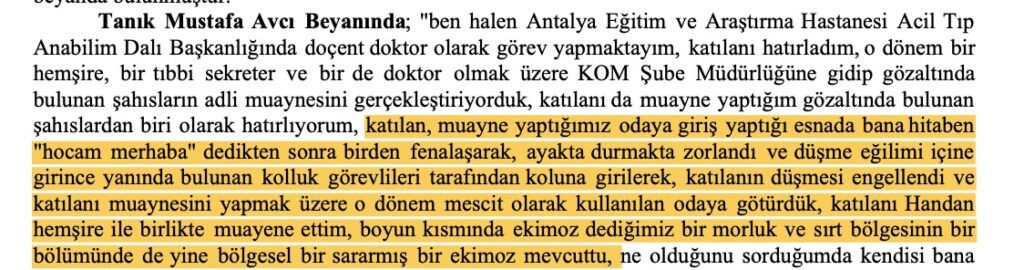
Emergency physician Orkun Gürbüz explained that Birinci had been transferred from the Sema Yazar Community Health Center to the Antalya Training and Research Hospital due to the deterioration of his condition; his general condition was poor, he had severe abdominal pain, could not speak, and was in life-threatening danger.
Further witnesses – including Sadullah Topuz, Fevzi Akça, İbrahim Özdemir, Umur Tekin, Hamza Balcı, Bahadır Dalkıran, Osman Aslan, Cevher Dağ, and Süleyman Hilmi Temiz – independently confirmed that Birinci was returned to custody after each interrogation severely mistreated, bleeding, barely responsive, or unconscious, and was finally taken away due to his critical condition.


Fig. 6-9: Collected witness statements from fellow prisoners confirming the signs of torture.
Betrayal of Medical Ethics: Denial of Torture in Custody
During custody, Eyüp Birinci was examined several times by the same doctor, who each time issued reports stating “no signs of mistreatment.” This doctor, Dr. Fevzi Yılmaz, stated in court that at the time he was serving as a professor at the Antalya Training and Research Hospital. Despite his academic rank and professional responsibility, he either conducted no serious physical examination or limited himself to superficial questions, despite visible injuries, bleeding, swelling, and severe complaints of pain. It was only the emergency physician who treated him later who recognized the internal bleeding and arranged for immediate hospital admission [5].
The repeated issuance of certificates without findings of mistreatment by a high-ranking doctor represents a central pillar of the mechanism of impunity in this case.

Investigation and Criminal Proceedings End in Impunity
Despite the extensive evidence, on January 9, 2026, all defendants – including the police officers and the professor – were acquitted by the Antalya 3rd High Criminal Court. The court relied on the principle of “in dubio pro reo” (benefit of the doubt) and ignored the totality of the consistent witness statements, medical findings, and the determinations of the Constitutional Court.

Not an Isolated Case, but a Structural Problem
The case of Eyüp Birinci is not an isolated incident. Like other proceedings, such as the case of Savaş Kasap, it demonstrates a structural pattern in which torture is constitutionally established but not criminally sanctioned.
Conclusion: A Complete Cycle of Impunity
In total, the case of Eyüp Birinci reveals a complete cycle of impunity: torture under complete state control, detailed and consistent witness testimony in court, medical complicity, delayed and ineffective constitutional court review, and ultimately an acquittal due to evidence deficits caused primarily by state failure. The case clearly shows that domestic legal remedies do not provide effective protection or genuine accountability for torture by security forces in practice.
Confirmed by International Oversight: Findings of the Council of Europe CPT
The medical complicity and the formulaic denial of mistreatment established in this case are not isolated but fit into a structural problem repeatedly documented by international monitoring mechanisms. The European Committee for the Prevention of Torture and Inhuman or Degrading Treatment or Punishment (CPT) of the Council of Europe has explicitly stated in several of its reports on visits to Turkey that medical examinations of persons in police custody are often inadequate, superficial, and purely formal in nature [6].
According to the CPT’s findings, medical examinations in custody situations are often carried out in the presence of police officers, without maintaining medical confidentiality, without a thorough physical examination, and without proper documentation of injuries. The committee has repeatedly highlighted that medical reports are often limited to standardized phrases, such as the categorical statement that there are “no signs of mistreatment,” without a genuine clinical examination having been undertaken.
The CPT has further emphasized that such formalistic medical examinations not only contradict the requirements of professional medical ethics but also play a central role in the concealment of torture and ill-treatment, thereby contributing systemically to impunity. In particular, it was criticized that injuries are either not documented at all or are falsely presented as caused by falls or self-harm, thereby effectively undermining subsequent criminal investigations.
Against this background, the behavior of the doctor charged in the present proceedings, who repeatedly issued reports stating “no mistreatment” despite obvious injuries and severe complaints, appears not as an individual failure but as part of a broader structural pattern repeatedly criticized by the CPT. The consistency between the CPT’s findings and the events in the case of Eyüp Birinci underscores that medical examinations in police custody in Turkey are in many cases degraded to a mere formality and effectively lose their central protective function against torture.
No comment yet, add your voice below!