

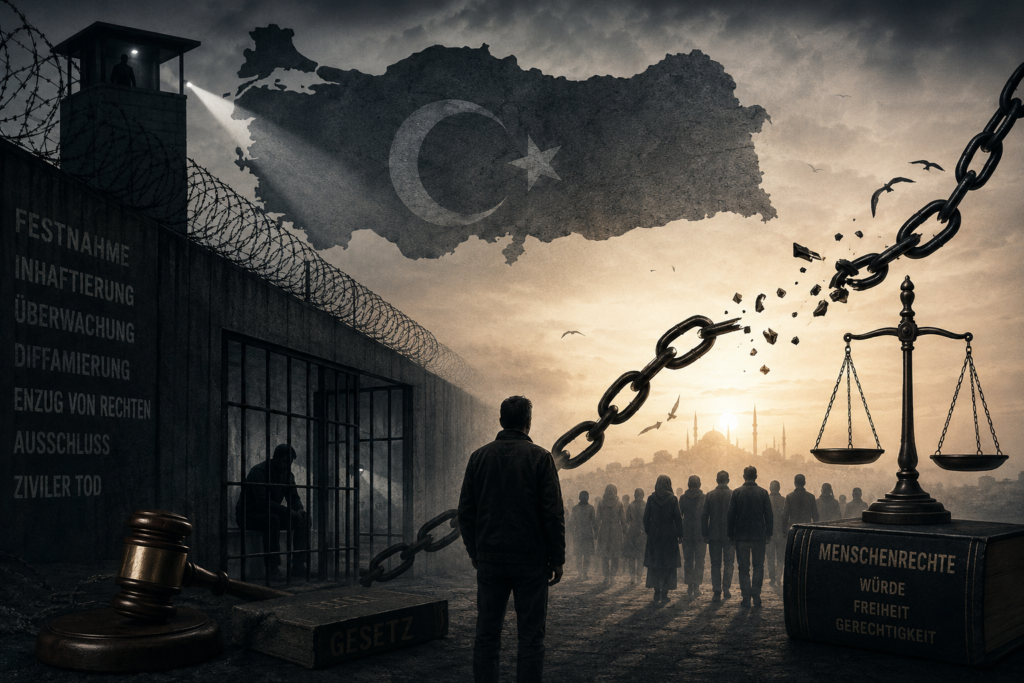
SYSTEMATIC PERSECUTION OF THE HIZMET MOVEMENT
IN TÜRKİYE AND CRIMES AGAINST HUMANITY
ANNUAL REPORT 2025
A documentation and legal assessment in light of Article 7 of the Rome Statute
Download pdf: SYSTEMATIC PERSECUTION OF THE HIZMET MOVEMENT 2025
SUMMARY
This report documents the arrests, detentions and judicial control measures carried out in Türkiye in 2025 against members of the Hizmet movement. It is based on publicly accessible official statements, operational announcements by the police and gendarmerie, and available open-source data. It assesses the documented practice according to the standards of international human rights protection and international criminal law.
The data for 2025 show that the practice in question exceeds the level of isolated security measures and displays a degree of continuity, coordination and systematic character that points to a different explanation: the measures conducted under the label of “terror operations” serve less to clarify specific acts of violence than to continuously reproduce a domestic political image of the enemy. Three findings support this conclusion in particular: the regular repetition of operations throughout the year, their simultaneous implementation in dozens of provinces at a time, and the almost verbatim recurrence of the same allegation patterns in official communications.
The allegations dominating the official statements, activity within the so-called “current structure”, contacts via public payphones, use of the ByLock messenger application, living in the same apartment, employment of persons dismissed by emergency decree, or joint business activity, overwhelmingly concern conduct that does not in itself constitute a criminal offence or whose connection to a specific violent act is not demonstrated. The investigative and prosecutorial practice is therefore not based on the determination of individual contributions to offences, but on the creation of collective suspicion on the basis of group and belief affiliation. This practice violates the presumption of innocence and systematically erodes the principle of legality, nullum crimen, nulla poena sine lege.
A particularly notable dimension of the operations is the criminalization of everyday social and economic life. Joint learning, sharing an apartment, operating a döner restaurant, a pastry shop or a grocery store, as well as small-scale agricultural production, are made the subject of criminal investigations under the allegation of terrorist financing. The practice therefore does not merely deprive people of liberty; it deliberately attacks the material foundations and dignity of the affected community and produces the effect of an economic and social mechanism of exclusion.
The vague terms constantly repeated in official language, “crypto-structure”, “secret imam”, “infiltration”, “cell apartment”, “restructuring”, function less as legal qualifications than as propaganda language designed to generate a permanent perception of threat. This language legitimizes arrests and detentions in the public sphere and simultaneously turns ordinary social relations, neighbourhood, friendship, commerce and solidarity, into objects of suspicion. It thereby damages the social fabric as a whole.
In their cumulative effect, these measures lead to the exclusion of members of the Hizmet movement and their families from public life, to the loss of employment, housing, education and livelihood opportunities, and to the reshaping of their social networks through criminal suspicion. The report describes this phenomenon as “civil death”, a form of punishment that extends beyond prison walls. In view of the severity of the social destruction, some observers also describe the events sociologically as “social genocide”; the legal assessment of this report, by contrast, deliberately remains within the framework of crimes against humanity under Article 7 of the Rome Statute, in particular persecution within the meaning of Article 7(1)(h).
The purpose of this report is not to allow the suffering endured to disappear behind the cold language of legal concepts, but to make it visible on the basis of data, to identify responsibility and to place on record for the international public the practice that continued in 2025.
Key Findings
- Construction of an internal enemy and continuity: The periodicity of the operations and the uniformity of official language indicate that the continuous reproduction of an enemy image is driven less by a security need than by an interest in political consolidation.
- Affiliation-based rather than act-based criminal law: Allegations such as “current structure”, “payphone contacts”, “ByLock”, “living in the same apartment” and “joint trade” form the core of the proceedings; individualized allegations have been replaced by a collective, affiliation-based logic of punishment.
- Criminalization of everyday life: The linkage of work, trade, mutual assistance and social contact with terrorism suspicion operates beyond punishment itself as a mechanism of social isolation of the target group.
- Dynamics of “civil death”: Through stigmatization, economic destruction, the severing of social ties and the narrowing of future prospects, punishment is extended beyond detention; the affected persons are effectively “made invisible while still alive”.
Methodology and Data Basis
The report is based on a dataset compiled from publicly accessible official statements, operational and judicial data documented in the press, statements by affected persons, conversations with defence lawyers, procedural documents, records from monitoring networks and systematic open-source research. The data were classified by date, number of affected provinces, type of measure, arrest, pretrial detention or judicial control measure, procedural outcome and fundamental-rights impact; quantitative indicators are combined with qualitative case descriptions in the sense of mutual validation.
As a methodological limitation, it must be noted that the allegations reproduced in the chronology are assertions by official bodies and not independently verified facts; the text consistently identifies them as such. Likewise, the arrest and detention figures are based on official communications; the actual figures are likely to be higher.
Recommendations
- To Türkiye: In investigations and criminal proceedings against members of the Hizmet movement, the individualization of the allegation must be strictly ensured; the subsumption of nonviolent acts under terrorism offences must be ended; detention and judicial control orders must be subjected to effective judicial review according to necessity and proportionality.
- To European institutions and international mechanisms: Regular reporting on the systematic pattern of repression, thematic sessions and country visits should be expanded; visible diplomatic and legal follow-up mechanisms should be activated against practices that erode fair trial rights and the principle of legality, above all the supervision by the Committee of Ministers of the implementation of the Yalçınkaya judgment under Article 46 ECHR.
- To civil society and monitoring networks: Data standards should be strengthened; a minimum dataset should be created for every operation, including date, province, allegation, procedural outcome and source; testimonies of affected persons should be collected under secure conditions, and indicators for measuring “civil death” should be integrated into reporting.
OVERALL PICTURE 2025 AND STATISTICAL OVERVIEW
The measures directed against the Hizmet movement in 2025 reveal less a prosecution of concrete violent or terrorist acts than a regime that places a particular identity and affiliation under permanent pressure. The repetition of the operations throughout the year, their simultaneous execution in a large number of provinces and the stereotypical recurrence of the same allegation patterns show that this is not ordinary security work, but an element of politically motivated enemy construction.
Official Annual Figures 2025
According to Interior Minister Ali Yerlikaya’s annual balance sheet, a total of 1,601 suspects were placed in pretrial detention in 2025 within the framework of operations against the Hizmet movement; judicial control measures were imposed on a further 1,524 suspects. This figure is consistent with the minister’s statement before the Grand National Assembly on 17 November 2025, according to which 1,395 persons had already been detained between 1 January and 31 October 2025. A consolidated official total number of arrests for 2025, however, was not published; the chronology of this report therefore documents the arrest figures mentioned in the individual statements operation by operation.
These figures are more than statistics. They stand for parents detained on legally questionable grounds, for families torn apart, for stigmatized people who lost their jobs, and for a state practice that inscribes itself into the memory of the affected children. The report therefore understands its task as keeping the human dimension visible behind the numbers.
For comparative classification: according to information compiled by human rights defenders through the portal Bold Medya, terrorism accusations were brought against 3,093,084 persons in Türkiye between 2016 and 2024; 527,100 persons were convicted of membership in a terrorist organization. Compared with the case numbers and conviction rates of other states and regions, magnitudes of this kind cannot be explained by ordinary criminal justice; they point to a politically motivated, affiliation-based indictment system.
Source: https://www.boldmedya.com/2025/11/21/turkiyede-soykirima-varan-sorusturmalar-2016-2024-arasinda-3-milyon-kisiye-terorist-suclamasi-yapildi/
Affected Persons by Month (Arrests)
| Month | Number of Affected Persons |
| January | 228 |
| February | 594 |
| March | 73 |
| April | 205 |
| May | 426 |
| June | 537 |
| July | 577 |
| August | 49 |
| September | 233 |
| October | 329 |
| November | 93 |
| December | 269 |
| TOTAL | 3,613 |
Note: The table reproduces the monthly totals compiled from publicly available operational statements. The October value, 329, is higher than the sum of the operations individually documented in this report; the difference is due to province-based measures that were not the subject of separate statements.

Figure 1: Affected persons by month, 2025 (arrests; compiled from operational statements).
The Recurring Pattern of Operational Statements
In the official statements of 2025, a substantial part of the allegations is not based on specific acts of violence, but on a fixed inventory of labels and formulas. Almost every operation uses the same key terms: “current structure”, “contacts via payphones”, “ByLock”, “Gaybubet apartment” (hideout apartment) and “secret imam”. The most serious consequence of this pattern is that, in an environment without individualization of the allegation, a collective suspicion is generated through mere affiliation: even persons without a final conviction can be publicly marked with the label “terror” and pushed out of social life.
Beyond the Numbers: Three Functions of the Operations
Psychological dominance and propaganda. The monthly repeated operations clearly aim to establish psychological dominance across the country and to anchor the conceptual association of “Hizmet movement” and “terror” in collective consciousness. In their staging, the operations bear less the features of a security measure than those of a ritual that consolidates the government’s own support base and keeps the enemy image alive.
Continuation of the narrative of the “internal enemy”. Although more than nine years have passed since the attempted coup of 15 July 2016, the perception of a “continuing threat” is deliberately maintained; in this way, authoritarian security policies are legitimized and society is kept in a state of permanent alert. It is notable that no armed incident was recorded in any of the documented operations, yet students and housewives are presented to the public under headlines such as “Major terror operation”.
“Civil death” and economic destruction. Another function of the operations is to close off access to economic life for members of the Hizmet movement. Legal joint business activity is criminalized under the allegation of terrorist financing; companies employing affected persons themselves become targets. The result is the systematic narrowing of the material foundations of the target group.
CHRONOLOGY 2025: THE OPERATIONS BY MONTH
The following chronology arranges the operational statements that became public in 2025 in chronological order. Its purpose is not the mere listing of individual events, but the data-based demonstration of a permanent system of pressure based on the repetition of identical patterns and its effect of “civil death” on the target group. The allegations reproduced are consistently assertions by official bodies.
14 January 2025: Operation “Kıskaç-34” (23 provinces, 110 arrests)
The first operation of the year was carried out on 14 January. Interior Minister Ali Yerlikaya announced that 110 suspects had been arrested within the framework of Operation “Kıskaç-34”, conducted simultaneously in 23 provinces under the coordination of the chief public prosecutors’ offices and the counter-terrorism (TEM), anti-smuggling and organized crime (KOM) and intelligence departments of the General Directorate of Security. They were accused of having been active within the “academic, military and current structure” of the organization, of living in so-called “Gaybubet apartments”, of maintaining contact with “responsible persons” via payphones, of having been “coded as preferred” in examination procedures and of having used ByLock. According to the statement, foreign currency, Turkish lira, documents and digital data carriers were seized.
Source: https://www.dha.com.tr/gundem/23-ilde-feto-operasyonu-110-gozalti-2565636
18 January 2025: Operation “Kıskaç-35” (23 provinces, 47 arrests; 33 pretrial detentions, 1 judicial control measure)
In the operation conducted in 23 provinces under the coordination of the Gendarmerie General Command, 47 persons were arrested; 33 of them were placed in pretrial detention, and judicial control measures were imposed on one person. The allegations included activity within the “current structure”, contacts via payphones, financing of the organization and propaganda on social media.
Source: https://www.aa.com.tr/tr/gundem/fetoye-yonelik-kiskac-35-operasyonlarinda-yakalanan-33-supheli-tutuklandi/3454218

Figure 2: Statement by Interior Minister Ali Yerlikaya on Operation “Kıskaç-35” (X, January 2025).
24 January 2025: Operation “Kıskaç-36” (27 provinces, 71 arrests)
Interior Minister Yerlikaya announced that 71 suspects had been arrested in Operation “Kıskaç-36”, led from Istanbul and carried out simultaneously in 27 provinces, including Ankara, Izmir, Antalya, Bursa, Kayseri, Manisa and Gaziantep. The allegations were activity within the “current structure”, propaganda on social media, payphone contacts and ByLock use. The statement did not explain what concrete connection to an offence existed among such a large number of persons across such a wide geographical area, nor on the basis of which individual acts the arrests were made. It was further stated that persons named in statements and confrontations, or persons against whom final prison sentences and wanted notices existed, had also been arrested; the minister emphasized the “determined” continuation of the measures.
Source: https://www.aa.com.tr/tr/gundem/fetoye-yonelik-kiskac-36-operasyonlarinda-71-supheli-gozaltina-alindi/3460873

Figure 3: Women arrested within the framework of the operations (press photo, January 2025).
4 February 2025: Operation “Kıskaç-37” (29 provinces, 93 arrests)
According to official information, 93 suspects were arrested in operations coordinated by the TEM, KOM and intelligence departments in 29 provinces, including Adana, Ankara, Antalya, Bursa, Istanbul, Izmir, Konya and Trabzon. The allegations concerned activity within the “secret military structure” and the “student structure”, payphone contacts and ByLock use. According to the statement, the arrested persons also included individuals who had been named in statements or against whom final sentences existed.
Source: https://www.aa.com.tr/tr/gundem/fetoye-yonelik-kiskac-37-operasyonlarinda-93-supheli-gozaltina-alindi/3471043

Figure 4: Image of a raid disseminated through official channels as part of the “Kıskaç” operations.
10 February 2025: Operation “Kıskaç-38” (22 provinces, 45 arrests; 24 pretrial detentions, 8 judicial control measures)
In the operation conducted in 22 provinces under the coordination of the Gendarmerie General Command, 45 persons were arrested; 24 were placed in pretrial detention, and judicial control measures were imposed on 8. The allegations were activity within the “current structure”, payphone contacts, financing of the organization and propaganda on social media.
Source: https://www.icisleri.gov.tr/kiskac-38-operasyonlarinda-45-supheli-yakalandi

Figure 5: Arrest as part of Operation “Kıskaç-38” (press photo, February 2025).

Figure 6: Presentation of the arrested persons at the courthouse (February 2025).
15 February 2025: Operation “Kıskaç-39” (39 provinces, 103 arrests)
According to official information, 103 persons were arrested in operations conducted in 39 provinces. The allegations included activity within the “secret military” and “student” structures, payphone contacts, “preferred coding” in selection procedures, “preparation for state examinations in organizational apartments”, living in “Gaybubet apartments” and ByLock use. Almost all allegations thus relate to patterns of conduct that either do not constitute a criminal offence or whose evidentiary value has been fundamentally called into question by the case law of the ECtHR.
Source: https://www.aa.com.tr/tr/gundem/fetoye-yonelik-kiskac-39-operasyonlarinda-103-zanli-yakalandi/3482788
21 February 2025: Operation “Kıskaç-40” / Maydonoz Döner (31 provinces, 353 arrests)
In Operation “Kıskaç-40”, led from Antalya and conducted simultaneously in 31 provinces, 353 suspects were arrested on the allegation that they had financed the organization through a döner restaurant chain, Maydonoz Döner. Subsequently, the state Savings Deposit Insurance Fund, TMSF, was appointed as trustee over 21 companies operating under the brand “Maydonoz Döner”. Referring to the death of Fethullah Gülen, the interior minister declared that there was “no room for any easing” in the “struggle”.
This operation crystallizes one of the report’s central findings: the fact that persons engage in trade together, establish companies and employ certain individuals was qualified as “terrorist financing”; on this basis, company assets were confiscated. Ordinary economic activity itself thereby becomes incriminating evidence.
Source: https://icisleri.gov.tr/kiskac-40-operasyonlarinda-353-supheli-yakalandi

Figure 7: Press report on the operation against the restaurant chain Maydonoz Döner: 353 arrests in 31 provinces, trusteeship over 21 companies.
19 to 27 March 2025: Simultaneous operations (27 provinces, 73 arrests; 48 pretrial detentions, 16 judicial control measures)
In operations conducted by gendarmerie and police units in 27 provinces, 73 suspects were arrested; 48 were placed in pretrial detention, and judicial control measures were imposed on 16. The allegations were activity within the “secret military and current structure”, payphone contacts, ByLock use, financing and social media propaganda. The announcement was made via the interior minister’s social media account, in a language, “secret structure”, “cell apartment”, “terror financing”, “secret communication”, designed to generate fear and anxiety.
Source: https://www.icisleri.gov.tr/19-27-mart-2025-tarihleri-arasinda-27-ilde-fetopdy-silahli-teror-orgutune-yonelik-operasyonlar-duzenlendi

Figure 8: Balance-sheet statement by the interior minister on the operations of 19 to 27 March (X).
11 April 2025: Operation against “digital and financial structures” (41 suspects, 36 arrests; 20 pretrial detentions, 16 judicial control measures)
In the operation led from Istanbul and involving Ankara, Yozgat and Gümüşhane, official sources stated that the “encrypted communication and foreign-funded financial networks” of the organization had been targeted. According to the statement, the investigation was triggered by the finding that persons who had been subject to judicial measures, dismissals or arrest records were socially insured at an Istanbul company. The company was accused of providing work to persons “close to the organization”, filling positions not according to qualifications but according to “organizational position”, and harming the state by enabling their retirement through the payment of social security contributions. According to the statement, 27,440 euros, 128,629 US dollars, 452,522 lira in cash and gold worth approximately 826,413 lira were seized, altogether assets with a market value of 7,358,559 lira, as well as digital data carriers and gift cards.
The operation marks the scope of the practice: even the employment and payment of persons stigmatized or convicted because of their affiliation with the Hizmet movement becomes the subject of investigation. The criminalization of employment itself demonstrates the institutionalization of the social isolation of the target group.
Source: https://www.aa.com.tr/tr/gundem/istanbul-merkezli-feto-operasyonunda-36-zanli-yakalandi/3534747
30 April 2025: Simultaneous operation in 42 provinces (169 arrests)
According to official information, 169 suspects were arrested in operations conducted in 42 provinces. The allegations included activity within the “current, financial, student and secret police and military structures” and within various professional groups, social media propaganda, payphone contacts, “preferred coding” in selection procedures and ByLock use. According to the statements, unregistered pistols and rifles as well as foreign currency, lira, documents and digital data carriers were seized.
Source: https://www.sabah.com.tr/gundem/2025/04/30/42-ilde-feto-operasyonu-169-supheli-yakalandi

Figure 9: Official statement on the operations in 42 provinces (X, 30 April 2025).
11 May 2025: Operation led from Gaziantep (47 provinces, 228 arrests; 77 pretrial detentions)
In operations coordinated by the Gaziantep Chief Public Prosecutor’s Office and the General Directorate of Security and carried out simultaneously in 47 provinces after one year of technical and physical surveillance, 228 suspects, including businesspeople, were arrested; 77 of them were placed in pretrial detention. The allegation was that meetings had been held in Türkiye and abroad through encrypted communication programs and that the organization had been financed through companies established by members.
Source: https://www.yenisafak.com/gundem/47-ilde-operasyon-duzenlenmisti-fetonun-yeni-taktikleri-desifre-oldu-4705822

Figure 10: Arrest by officers of the counter-terrorism unit (TEM) during the operation led from Gaziantep (press photo).
16 May 2025: Simultaneous operation in 27 provinces (101 arrests)
In operations conducted under gendarmerie coordination in 27 provinces, 101 suspects were arrested. The allegations were activity within the “current structure”, the use of payphones and “organization-specific communication methods”, social media propaganda and financing.
Source: https://haber240.com/gundem/fetoye-27-ilde-operasyon-101-kisi-gozaltinda-20388h

Figure 11: Official statement on the gendarmerie operations in 27 provinces (X, 16 May 2025).
23 May 2025: Operation against military personnel (36 provinces, 63 arrest warrants; 56 arrests)
Arrest warrants were issued against 63 active military personnel on the grounds that they were connected to the attempted coup of 15 July 2016; in operations led from Istanbul and conducted in 36 provinces, 56 of them were arrested. The affected persons belonged to the Air Force (8), the Army (36), the Navy (6) and the Gendarmerie General Command (13); their ranks ranged from 4 colonels, 8 lieutenant colonels, 12 majors and 15 captains to 24 non-commissioned officers.
The same statement published the cumulative balance sheet of measures directed against military personnel: since 15 July 2016, 1,915 operations had been carried out against soldiers; 28,194 persons had been recorded, 25,801 arrested, 8,992 placed in pretrial detention, 13,968 released under judicial control measures and 2,841 released without measures; 2,393 suspects were considered fugitives. The fact that the operations continue almost nine years after the attempted coup and after investigations against millions of persons with unchanged intensity supports the assessment that the perception of threat is kept on the agenda for political reasons.
Source: https://tr.euronews.com/2025/05/23/15-temmuz-darbe-girisimiyle-iliskili-63-askeri-personel-hakkinda-gozalti-karari

Figure 12: Press report: “56 active soldiers arrested” (23 May 2025).
28 May 2025: Operation led from Izmir (34 arrest warrants)
Within the framework of an operation based on the allegation of the “current structure”, arrest warrants against 34 persons were announced. The suspects were accused of using pastry and künefe businesses as “sham companies”, making deductions from employees’ wages and transferring them to the organization under the name “Himmet”, holding “organizational meetings” in the businesses and transferring financial resources amounting to 40 million lira in this way; the use of the business “like a cell apartment” was also among the allegations.
Source: https://www.aa.com.tr/tr/gundem/fetoye-yonelik-izmir-merkezli-operasyonda-yakalanan-13-supheli-
24 to 27 June 2025: Nationwide operations (46 provinces, 361 arrests)
In operations conducted simultaneously in 46 provinces under the coordination of the ministry, a total of 361 persons were arrested. The allegations were activity within the “current structure”, the “secret military structure”, the financial network and the “current educational structures”, ByLock use, payphone contacts and social media propaganda.
The simultaneous counter-statement by journalist Sevinç Özarslan documents the gap between the official account and the actual events: in Izmir alone, 45 persons, including 38 female students, were reportedly arrested, their sole allegation being that they lived in the same apartment. Children of parents imprisoned because of their affiliation with the Hizmet movement are detained because the student apartments they share are qualified as “cell apartments of the organization” and placed under the allegation of “restructuring”.
Source: https://www.trthaber.com/haber/gundem/fetoye-46-ilde-operasyon-361-gozalti-912085.html; https://x.com/sevincozarslan/status/1938482407876805051

Figure 13: Arrests during the operations at the end of June (press photo).

Figure 14: Official statement: 361 arrests in 46 provinces (X, June 2025).

Figure 15: Counter-statement by journalist Sevinç Özarslan: “Not terrorists, but female students were hunted” (X, 27 June 2025).
24 June 2025: Arrest warrants against military personnel (31 provinces, 176 persons)
Within the framework of an investigation led by the chief public prosecutors’ offices of Istanbul and Izmir, which according to the official account targeted the “structure of the movement within the armed forces”, a simultaneous operation was conducted from Istanbul in 31 provinces; arrest warrants were issued against a total of 176 active and former soldiers. The Istanbul Chief Public Prosecutor’s Office stated that the central investigative method consisted of identifying contacts allegedly made by “civilian persons responsible for soldiers” via prepaid telephone lines in kiosks, markets and payment points as well as via public payphones; arrests and detentions were based on these connection data. The fact that such connection data serve as central incriminating evidence raises serious questions of legality and fair trial in light of the Yalçınkaya case law of the ECtHR.
Source: https://www.trthaber.com/haber/gundem/feto-sorusturmasinda-176-askere-gozalti-karari-911690.html
1 July 2025: Operation in 30 provinces (156 arrests)
In operations conducted under gendarmerie coordination in 30 provinces, 156 persons were arrested. The allegations were activity within the “current structure”, payphone contacts, financing and social media propaganda. In this wave as well, numerous students were arrested and detained under the allegation of the “current structure”.
Source: https://www.turkiyegazetesi.com.tr/gundem/30-ilde-feto-operasyonu-156-kisi-yakalandi-1127533
14 July 2025: Operation in 20 provinces (50 arrests; 33 pretrial detentions, 5 judicial control measures)
In operations conducted in 20 provinces, including Ankara, Bursa and Izmir, 50 suspects were arrested; 33 were placed in pretrial detention, and judicial control measures were imposed on 5. The allegations included activity within the “current structure”, payphone contacts, the financing of “so-called aid organizations close to the organization” and social media propaganda.
Source: https://x.com/AliYerlikaya/status/1944631748605657119
15 July 2025: Operations on the 9th anniversary of the attempted coup (60 provinces, 371 arrest warrants)
On the anniversary of 15 July, large-scale operations are regularly carried out, presented in pro-government media under headlines such as “major terror operation” and clearly serving to consolidate public perception. It is notable that no armed incident occurred in any of these operations and not a single weapon or item of ammunition was seized; a significant proportion of the arrested persons are students accused of “restructuring” or whose shared apartments are qualified as “cell apartments”.
In this context, arrest warrants were issued on 15 July 2025 against 371 suspects in an operation led from Izmir and covering 60 provinces. In a separate procedure led from Istanbul, the supermarket chains HAKMAR and TATBAK were placed under trusteeship and their assets confiscated on the allegation of financing the Hizmet movement. According to the official account, funds had been collected through fictitious food sales to persons “recorded for FETÖ membership” in Türkiye and abroad and forwarded as “food packages” to members of the organization. The fact that even food assistance for affected families is qualified as terrorist financing shows the extent of the criminalization.
Source: https://www.indyturk.com/node/761869/haber/15-temmuz%E2%80%99un-9-
16 August 2025: Simultaneous operation in 29 provinces (49 arrests)
In operations conducted by the gendarmerie in 29 provinces, 49 suspects were arrested. The allegations were activity within the “current structure”, payphone contacts, the financing of “so-called aid organizations close to the organization” and social media propaganda.
4 September 2025: Operation in 21 provinces (41 arrests)
In operations conducted in 21 provinces, including Istanbul, Ankara and Izmir, 41 arrested persons were accused of having been active within the “IT structure and the current structure”, maintaining contact with “responsible persons” and living in “Gaybubet apartments”.

Figure 16: Press report on the operations in 21 provinces (4 September 2025).
10 September 2025: Operation in 19 provinces (53 arrests; 40 pretrial detentions)
In operations conducted in 19 provinces, 53 suspects were arrested; 40 of them were placed in pretrial detention. According to official information, the measures were directed against persons linked to the “current structure”, the use of payphones, and propaganda and financing activities. The fact that three quarters of those arrested were detained is a striking indication that pretrial detention has become the rule rather than the exception.

Figure 17: Press report: 40 of 53 arrested persons placed in pretrial detention (10 September 2025).
21 September 2025: 39 operations within one week (97 arrests); investigations in the Ministry of Foreign Affairs
The Interior Ministry announced that 39 separate operations had been carried out within one week and 97 suspects arrested. In this context, on 17 September 2025, arrest warrants were issued against 15 persons in the course of investigations into the “secret structure” in the Ministry of Foreign Affairs. According to the investigations led by the Ankara Chief Public Prosecutor’s Office, the suspects are accused of ByLock use, “sequential” calls from payphones and landlines, and being named in third-party statements; 6 of them had previously been removed from service, 8 were still on active duty at the Ministry of Foreign Affairs, and 1 person was employed at another authority.
30 September 2025: Operation led from Izmir against the “military structure” (16 provinces, 42 arrest warrants)
Within the framework of an investigation led from Izmir, operations were carried out in 16 provinces; arrest warrants were issued against 42 suspects on the allegation of links to the “secret military structure”.
3 October 2025: Operations in 30 provinces (91 arrests; 64 pretrial detentions, 3 judicial control measures)
Interior Minister Yerlikaya announced that 91 suspects had been arrested in operations conducted by the gendarmerie in the preceding two weeks in 30 provinces; 64 of them had been placed in pretrial detention, and judicial control measures had been imposed on 3. The operations covered, among others, Ankara, Antalya, Aydın, Bursa, Denizli, Edirne, Eskişehir, Gaziantep, Hatay, Istanbul, Izmir, Kahramanmaraş, Kayseri, Konya, Kütahya, Manisa, Mardin, Mersin, Muğla, Ordu, Osmaniye, Sinop, Tekirdağ, Trabzon and Yozgat. The allegations were activity within the “current structure”, payphone contacts, financing and social media propaganda.
The fact that the allegations are overwhelmingly based on terms of doubtful evidentiary value and that the detention rate exceeds 70 percent supports the assessment that the aim is not criminal prosecution, but collective punishment.

Figure 18: Arrest by gendarmerie units (press photo, October 2025).
30 October 2025: Operation led from Istanbul (11 provinces, 22 arrests; 10 pretrial detentions)
Within the framework of an investigation by the Istanbul Chief Public Prosecutor’s Office, 22 suspects were arrested in an operation carried out simultaneously on 28 October in Ankara, Elazığ, Gaziantep, Giresun, Kahramanmaraş, Kocaeli, Manisa, Mersin, Tekirdağ and Trabzon. After the prosecutorial interrogations, the criminal judgeship of peace ordered pretrial detention for 10 suspects and judicial control measures for the others. The statements highlighted the term “secret imam structure”; a significant proportion of the suspects had evidently been removed from public service years earlier.
The evidentiary basis of the proceedings is notable: statements by cooperating witnesses, datasets on an SD card belonging to an anonymous witness with the code name “Garson” (“Waiter”), account movements at Bank Asya, and “sequential” calls qualified as the organization’s “secret communication method”. All of these types of evidence raise serious questions of reliability and legality in light of the principles developed in the Yalçınkaya judgment of the ECtHR.

Figure 19: Transfer of suspects in the operation led from Istanbul (press photo, October 2025).
17 November 2025: Simultaneous operation in 27 provinces (71 arrests)
In operations coordinated by the Istanbul Chief Public Prosecutor’s Office and the Istanbul Police Directorate and carried out simultaneously in 27 provinces, including Ankara, Izmir, Antalya, Bursa, Kayseri, Manisa and Gaziantep, 71 suspects were arrested. According to the prosecutor’s statement, the investigation targeted 80 persons qualified as “secret police imams” within the “secret police structure”; 40 of them were public officials, including teachers, academic staff and medical personnel, and 40 were employed in the private sector. According to the statement, 8 suspects were abroad and 1 person was wanted. The evidence cited included cooperating-witness statements, sequential call logs, ByLock use and transactions at Bank Asya.
The fact that the target group consists mainly of current or former public-sector employees and that the model of simultaneous large-scale raids was chosen points to the intimidation and mass-impact function of the practice. In the same period, the interior minister stated before parliament that 1,395 suspects had been detained in this context between 1 January and 31 October 2025. Simultaneous raids in 20 to 30 provinces create throughout society the perception of an ever-present threat of state intervention and thereby directly impair the right to liberty and security.

Figure 20: Arrest in front of the Nizip District Gendarmerie Command (official dissemination, November 2025).
18 November 2025: Operation by the Ankara Chief Public Prosecutor’s Office (9 provinces, 22 arrest warrants)
The Ankara Chief Public Prosecutor’s Office announced that, within the framework of investigations into the “secret services structure” within the Army, arrest warrants had been issued against 22 suspects. They were accused of having maintained contact with their “secret imams” via public payphones. Among those sought were reportedly 8 active soldiers, 6 retired soldiers, 4 soldiers previously dismissed from the army, 3 public officials and 1 person employed in the private sector; the operations were carried out in Ankara and eight other provinces.
In a significant proportion of the proceedings, the allegation is based on connection-data analyses, past social contacts and witness statements. The weight of cooperating-witness statements suggests that the cooperating-witness regime has effectively become a system for producing statements.

Figure 21: Image disseminated by official bodies concerning the operation of the Ankara Prosecutor’s Office.
9 December 2025: Operation against the “financial network” (6 provinces, 13 arrest warrants)
In operations carried out simultaneously in six provinces under the coordination of the Ankara Chief Public Prosecutor’s Office, arrest warrants were issued against 13 suspects on the allegation of being active in the organization’s “financial network”. They were accused of forwarding collected funds to persons against whom judicial measures had already been taken, or to their families, and of participating in “entrepreneurial structures”. The fact that material support for families with imprisoned relatives is prosecuted as a terrorism offence shows that the criminalization mechanism even encompasses humanitarian solidarity.
16 December 2025: Operation in 39 provinces (160 arrest warrants; 90 pretrial detentions)
In operations conducted under the coordination of the TEM, KOM and intelligence departments in 39 provinces, including Istanbul, Ankara and Izmir, arrest warrants were issued against 160 persons; 90 were placed in pretrial detention. The allegations were ByLock use, payphone contacts and activity within the “secret services structure” of the Ministry of Foreign Affairs as well as the “current”, “educational”, “financial” and “secret military” structures.
21 December 2025: Gendarmerie operation in 28 provinces (76 arrest warrants; 50 pretrial detentions)
In operations conducted by gendarmerie units in 28 provinces, arrest warrants were issued against 76 persons; 50 of them were placed in pretrial detention. Mass arrests and mass detentions carried out across such a wide geographical area without specification and individualization of the allegation are a clear indication that persons are treated as members of a terrorist organization solely on the basis of their religious or worldview affiliation.
25 December 2025: Operation “secret structure in public service” (20 arrests)
Under the coordination of the terrorism investigations bureau of the Ankara Chief Public Prosecutor’s Office, 20 persons, including public officials, were arrested within the framework of investigations into the “secret structure in public service”, directed against the Ministry of Foreign Affairs, the Ministry of Education, and the Ministry of Finance and subordinate authorities. They were accused of communicating via “special and secret lines”; cooperating-witness statements and records of “sequential or individual” calls from payphones and landlines were also said to exist. Of the affected persons, 5 were in active service, 14 were previously dismissed public officials, and 1 person was a civilian.
In summary, according to Interior Ministry data, as a result of the operations continued without interruption in 2025 by police and gendarmerie units, a total of 1,601 suspects were placed in pretrial detention; judicial control measures were imposed on 1,524 suspects.
CASE ANALYSES
The following cases were selected in order to concretize, at the level of individual fates, the patterns demonstrated by the quantitative data. The information is based on statements by affected persons, their defence lawyers and open sources.
Case 1: Student apartment or “cell apartment”? (Operations June to July 2025)
In the operations of 24 to 27 June and 1 July, students were specifically targeted under the allegation of the “current structure”. The 21-year-old student A.K., who studies in Izmir, was arrested in the apartment she had rented together with fellow female students in order to share costs. Everyday circumstances, the textbooks found in the apartment, joint grocery purchases and observance of a household order, were qualified by the prosecutor’s office as “organizational discipline” and “activity of a cell apartment”. Although A.K. was not linked to any violent act, the fact that her parents had been dismissed by emergency decree and her religious lifestyle were sufficient for the allegation of “membership in a terrorist organization”.
The case illustrates how the principle of personal criminal liability is breached and responsibility is extended through family ties and social environment. A practice that reaches even the children of members of the Hizmet movement recalls the institution of Sippenhaft known from German legal history and recognized there as unlawful.
Case 2: From slicing döner to “terrorist financing” (Operations February 2025)
In the operation against the Maydonoz Döner chain on 21 February 2025, 353 persons were arrested. The teacher M.Y., dismissed by emergency decree, had begun working as a waiter in one of the chain’s establishments in order to secure his livelihood. His receipt of wages and WhatsApp correspondence with colleagues were treated as incriminating evidence under Law No. 6415 on the Prevention of the Financing of Terrorism; the fact that part of the business profit was passed on as food aid to families of detainees was regarded as “organizational financing”. With the criminalization of the economic activity of persons trying to remain in working life, M.Y. lost both his work and his liberty; the case illustrates the economic dimension of “civil death”.
Case 3: “Stretched death” in prisons: seriously ill pretrial detainees
Data and testimonies from 2025 show that the practice of delaying treatment for seriously ill prisoners, in its actual consequences, amounts to a nullification of the right to life. Illnesses are driven into an irreversible stage through bureaucratic obstacles, the rejection of transfer requests, forced examinations in handcuffs and “fit for detention” reports by the Forensic Medicine Institute (ATK); once death becomes unavoidable, release takes place so that the death is not statistically recorded as a “death in custody”.
(a) Lawyer Süleyman Yıldırım. The requests by lawyer Süleyman Yıldırım, imprisoned within the framework of Hizmet-related proceedings, for transfer to a full-service hospital were rejected for months despite the serious illness that was worsening in detention, with references to “lack of personnel”, “unavailable appointments” and “security reasons”; the illness progressed under the superficial treatments of the prison infirmary. Even after diagnosis, access to life-sustaining therapies remained disrupted; the ATK certified his fitness for detention even at an advanced stage. The execution of the sentence was postponed only when Yıldırım no longer responded to any treatment. He died at home around three months after his release. The course of events exceeds a violation of the state’s duty to protect life under Article 2 ECHR and reaches the dimension of inhuman treatment within the meaning of Article 3 ECHR.
(b) English teacher Hakan Kanat. Hakan Kanat was diagnosed with thyroid cancer while in pretrial detention in Kırşehir Prison. At the stage when surgery was required, his transfers were delayed and his access to treatment restricted. Despite warnings by his family and defence lawyers of danger to life, the detention was maintained; Kanat was released only after the cancer had metastasized and no medical intervention was still possible. He died shortly afterwards. His petitions, which became known after his death, document that his pleas to survive remained unanswered.
Taken together, the two cases show that these were not isolated acts of negligence, but a prison practice that uses illness as an instrument of punishment and accepts its foreseeable consequences.
Legal assessment. The cases go beyond the phenomenon described in the literature on detention conditions as “slow death”: the state prevents treatment despite knowledge of the illness, foresees the occurrence of death and accepts it. Domestically, this raises the question of intentional killing by omission under Article 83 of the Turkish Criminal Code; if applied systematically against a particular group, assessment under Article 7(1)(b), “extermination”, and Article 7(1)(k), “other inhumane acts”, of the Rome Statute is required. According to the case law of the ECtHR, the continued detention of a terminally ill prisoner, or release only in the final moments of life, already violates the prohibition of inhuman treatment (Gülay Çetin v. Turkey, no. 8714/08, 5 March 2013).
OPERATIONAL TRENDS AND DATA ANALYSIS 2023 TO 2025
The data published at regular intervals by the Interior Ministry and the open-source analysis show that the waves of mass arrests that began after 15 July 2016 continue nine years later as a systematic state routine. The political leadership has continued its operational activity without interruption even after the death of Fethullah Gülen, invoking the “prevention of easing” and the “prevention of restructuring”.
| Year | Operations | Arrests | Pretrial Detention |
| 2023 | 6,775 | 9,639 | 1,689 |
| 2024 (Jan. to Oct.) | approx. 4,100 | approx. 7,500 | 1,400+ (end of year approx. 1,700) |
| 2025 | not specified | approx. 3,613 (from statements) | 1,601 (+1,524 judicial control measures) |
Sources: Activity data of the Interior Ministry for 2023 and public statements by Minister Yerlikaya; the values for 2024 are based on official figures for the first ten months; the 2025 arrest total was calculated from the chronology of this report.
In the overall picture, the detention figures, after the record values of 2023, stabilized in 2024 and 2025 at a steady base level, annually 1,500 to 1,700. This very stability argues against the assumption of a response to an acute security situation: it demonstrates that the operations have solidified into a permanent, effectively quota-like administrative practice whose purpose is to keep a particular social milieu under permanent pressure.
INDICTMENT PATTERNS AND CRIMINALIZATION MECHANISM
This section systematizes the allegation patterns that recur in 2025, that is, the identical architecture of suspicion produced through identical formulas. The described repression regime deals less with individual acts than it targets an entire community through the repetition of specific labels. These labels do not remain in procedural files; they migrate into headlines, social media, neighbourhood relations and working life. As a result, not only the freedom of the affected persons is attacked, but also their social existence.
1. The Logic of Affiliation-Based Accusation
The common language of the operational statements in 2025 does not attach to individual acts, but to affiliation. The “FETÖ” framework continuously reproduced in official rhetoric and the security apparatus carries a membership-based policy of hostility. Hundreds of persons are accused and detained within the same conceptual framework without their actions being examined individually or concrete allegations being specified. The affected persons are publicly convicted before they enter a courtroom; stigmatization and exclusion from civil life function as a de facto punishment independent of the judgment. State penal power therefore operates not only through court decisions, but also through social isolation.
2. The Criminalization of Housing and Social Contact
Students who share an apartment are detained under the labels “Gaybubet apartment” and “cell apartment”. Living under one roof, belonging to the same environment, working in the same company, going to the cinema or on a picnic together, elementary facts of everyday life can suddenly be transformed into criminal conduct. This practice affects the persons concerned not only legally, but also socially: by criminalizing even job searches, gatherings and shared leisure time, all social ties of the target group are severed. In this way, the mechanical procedure of condemnation to “civil death” is kept in motion.
3. Vague, Fear-Inducing Labels
The operational statements use vague, alarming formulas, “crypto-structure”, “secret imam”, “infiltration”, “cell apartment”, “restructuring”, that are continuously repeated and shape public perception. The language used is not legal, but propagandistic; social suspicion is kept permanently alive, and the human features of the target group are erased from the public image until only the abstract figure of a “threat” remains. Material assistance for affected families or shared housing by students can be treated under the heading of “current structure” as terrorist activity.
4. The Criminalization of Ordinary Business Activity: the Allegation of “Terrorist Financing”
Another tendency frequently observed in 2025 is the linkage of economic activity with the language of accusation. Livelihood-securing practices, döner snack bar, pastry shop, grocery store, small-scale production, farm products, craft sales, are criminalized through the topic of “terror financing”. The particular weight of this type of allegation lies in the fact that it affects not only the person, but the basis of existence: whoever loses the source of income together with his or her family loses, alongside liberty, the possibility of sustaining life. This is the directly economic dimension of condemnation to “civil death”.
LEGAL FRAMEWORK: THE VIOLATED FUNDAMENTAL PRINCIPLES
The following section assigns the documented allegation patterns to the violated fundamental principles of national and international law.
Principle of Legality (Art. 7 ECHR; Art. 15 ICCPR; Art. 38 Turkish Constitution)
According to the fundamental principle of criminal law, offence and punishment must be defined by law, and the individual must be able to foresee what conduct will lead to what sanction. This principle is guaranteed not only by Article 38 of the Turkish Constitution, but also by Article 7 ECHR and Article 15 of the International Covenant on Civil and Political Rights. As the report documents, the scope of criminality is expanded through vague labels; the principle of legality is thereby effectively eroded, and the affected persons are placed in a state of legal unforeseeability. In the judgment Yüksel Yalçınkaya v. Türkiye, the ECtHR identified precisely this pattern, the quasi-automatic conversion of circumstances such as ByLock use into a conviction for membership, as a violation of Article 7.
Presumption of Innocence (Art. 6(2) ECHR; Art. 14(2) ICCPR)
The presumption of innocence requires that every person be treated as innocent until guilt is legally established. The form in which the operations are publicly presented systematically violates this presumption: the simultaneous announcement of large numbers of persons in identical headline language, and the media display of images and identities, create social prejudgment already at the investigation stage. The affected persons lose employment, reputation and social environment before they stand trial, one of the fastest paths into “civil death”.
Individualization of the Allegation and the Principle of Personal Criminal Liability
Criminal law is directed at persons, not communities; the allegation must attach to the concrete act of the person and must identify time, place, intent and effect. In the statements of 2025 and the documented cases, by contrast, allegations are formulated predominantly without individualization and embedded in an affiliation narrative. Everyday behaviours, living in the same apartment, working in the same business, trading together, social contact, are made the basis of terrorism suspicion without being connected to a concrete violent act. The affected persons are judged not according to their acts, but according to their networks of relationships and affiliation; this is the open logic of collective punishment.
Right to Liberty and Security; Prohibition of Arbitrariness (Art. 5 ECHR; Art. 9 ICCPR)
Deprivation of liberty is permissible only insofar as it is lawful, necessary and proportionate. The continuity of the operations, their geographical scope and the affiliation-based mass arrests and detentions show that deprivation of liberty has become a widespread practice rather than an exception. The fact that detention decisions are not based on an examination of necessity and proportionality, but fulfil an intimidation function, gives the practice a structurally arbitrary character and satisfies the criteria of arbitrary detention within the meaning of Article 9 ICCPR.
Right to a Fair Trial and Evidentiary Standard (Art. 6 ECHR)
A fair trial is not a formality confined to the courtroom; the reliability of evidence, the manner in which it is obtained, the establishment of its connection to the person and the reality of adversarial proceedings are among its core elements. As the ECtHR has emphasized in its judgments concerning Hizmet-related proceedings, the boundaries of criminal law are expanded in a shapeless manner, legal acts are treated as incriminating evidence and criminal proceedings are diverted through the topic of counter-terrorism. The excessive reliance on cooperating-witness statements, the abstract nature of the evidence and the practice of collective proceedings are incompatible with the standards of Article 6.
Freedom of Expression and Association; the Narrowing of Civic Space (Arts. 10 and 11 ECHR)
The repression regime is not confined to criminal law; it weakens the civic fabric of society as a whole. The fact that every social contact, every act of assistance, every business relationship, sometimes even a greeting, with the target group can trigger suspicion effectively restricts the freedoms guaranteed by Articles 10 and 11 ECHR. People fall silent, withdraw and become invisible; this process forms the social dimension of condemnation to “civil death”.
Freedom of Religion and Conscience; Prohibition of Discrimination (Arts. 9 and 14 ECHR)
The fact that the operations selectively affect a belief-shaped community creates belief-based stigmatization and impairs freedom of thought, conscience and religion protected by Article 9 ECHR. The fact that the same practice is directed exclusively against this community also raises serious questions under the prohibition of discrimination in Article 14.
“Civil Death” and Its Contact with International Criminal Law
The practice against the Hizmet movement that has continued for nearly a decade is not exhausted by detentions and prison sentences. Exclusion from employment, criminalization of trade, stigmatization, the severing of social ties, the targeting of children and the destruction of future prospects condense into a practice that condemns the target community step by step to “civil death”. The intensity, duration and state coordination of this practice require assessment not only at the level of human rights violations, but also under Article 7 of the Rome Statute, namely under the offences of persecution (Article 7(1)(h)) and systematic deprivation of liberty (Article 7(1)(e)).
INTERNATIONAL REACTIONS AND LEGAL ANALYSIS (2025)
The practice presented by the Turkish government as an “internal matter” was consistently assessed and criticized by international mechanisms in 2025 as unlawful.
1. European Commission Türkiye Report (November 2025)
The European Commission’s enlargement reports continue to state that the judiciary is used as an instrument to suppress political opposition. The reports emphasize that the concept of terrorism is interpreted with a breadth incompatible with international norms and that the law is instrumentalized; the types of evidence underlying the “Kıskaç” operations, ByLock, account movements and others, would not in themselves be sufficient for conviction under European standards.
2. The ECtHR Judgment Yüksel Yalçınkaya and the Continuing Practice
In the judgment Yüksel Yalçınkaya v. Türkiye (no. 15669/20, 26 September 2023), the Grand Chamber of the ECtHR held that the quasi-automatic conversion of circumstances such as ByLock use and account movements at Bank Asya into a conviction for membership in an armed terrorist organization violated Article 7 ECHR, no punishment without law, Article 6(1), fair trial, and Article 11; the Court emphasized the structural character of the problem and pointed to the need for general measures under Article 46. The fact that the same criteria continue to serve as the central basis of accusation in the operations of 2025 demonstrates Türkiye’s open disregard of its Convention obligations.
3. Committee of Ministers of the Council of Europe (2025)
At its meetings in June, September and December 2025, the Committee of Ministers found that Türkiye is not implementing the Yalçınkaya judgment; it identified the systemic character of the violation and kept supervision under Article 46 on the agenda.
4. Torture and Ill-Treatment: the CPT Report 2025
The report of the European Committee for the Prevention of Torture (CPT), published in February 2025, points to overcrowding in Turkish prisons and deficiencies in access to health care. The finding documented there of “obstruction of access to treatment for ill prisoners” coincides with the pattern described in Case 3 of this report and supports assessment under Article 7(1)(k) of the Rome Statute.
5. Human Rights Watch, World Report 2025
HRW characterizes the situation in Türkiye in its World Report 2025 as the “normalization of repression”; judicial harassment of persons with links to Hizmet has become routine, and anti-terror legislation is being misused to silence civil society.
The mechanisms of the United Nations also repeatedly emphasize that the broad and vague application of counter-terrorism law intensifies restrictions on civic space, damages freedom of expression and association, and that the criminalization of ordinary social and economic activities is incompatible with human rights. These findings reinforce the core thesis of the report: terrorism allegations that attach to everyday nonviolent relationships and livelihood practices are an unacceptable abuse of power not only under national law, but also under international human rights standards.
CONCLUSION AND OVERALL ASSESSMENT
When the operations of 2025 are viewed in their entirety, it becomes clear that almost all allegations attach to patterns of conduct of which the ECtHR and the UN Human Rights Committee have repeatedly found that they do not in themselves constitute a criminal offence.
The operations conducted throughout the year demonstrate that state practice toward the Hizmet movement has left the framework of individual criminal prosecution and has turned into a regime of collective punishment based on belief and affiliation. Without proof of concrete violent acts, social relations, economic activities and everyday life practices are made the central element of the terrorism allegation; through official rhetoric and pro-government media, the target group is systematically dehumanized. This picture does not testify to a security need, but to the continuation of a political-ideological construction of an enemy image.
The suspicion-generating system of this regime is not based on the concrete connection between act and perpetrator, but on a structure indexed to identity and affiliation. Abstract labels such as “current structure”, “crypto-structure” and “secret organization” have replaced the determination of criminal conduct; criminal law is transformed from an instrument of truth-finding into an instrument of intimidation. The fact that people live together, support one another, work in the same business, establish companies, run businesses, pay wages and trade is converted into a terrorism allegation without reference to a concrete violent act, in systematic violation of the principle nullum crimen sine lege.
Judicial proceedings are accompanied by factual enforcement effects in society: stigmatization, exclusion from work, restriction of housing, damage to the educational and social environments of children, and the tearing apart of neighbourhood and family ties condemn the affected persons step by step to “civil death”.
In legal terms, it follows that arrests and detentions in 2025 were not based on concrete violent acts, but on presumptions of affiliation; this produces arbitrary deprivation of liberty, violation of the right to a fair trial, narrowing of the space of religious freedom and systematic violation of the prohibition of discrimination. The practice therefore violates Articles 5, 6, 9 and 14 ECHR as well as Articles 9 and 18 ICCPR.
The nationwide continuity of the operations, their coordination by state bodies and their orientation toward a specific social segment make an assessment beyond the level of human rights violations unavoidable from the perspective of international criminal law. The result is a permanent state practice aimed at the economic, social and legal elimination of a community. This finding contains elements that must be seriously discussed within the framework of Article 7 of the Rome Statute, namely persecution (Article 7(1)(h)) and systematic deprivation of liberty (Article 7(1)(e)).
The picture of 2025 shows that the judicial practice conducted under the title of counter-terrorism has become a system of social displacement, a system that criminalizes even the most ordinary everyday acts, pushes the affected persons to the margins of society, isolates them socially and destroys their future. The aim of this report is to make visible both the legal violations of this system and the human wreckage it leaves behind.
Bibliography
1. Legal Sources and International Instruments
International Criminal Court. (1998). Rome Statute of the International Criminal Court, in particular Article 7: Crimes against humanity. URL: https://www.icc-cpi.int/sites/default/files/2024-05/Rome-Statute-eng.pdf. Accessed: 15.06.2026.
International Criminal Court. (2011). Elements of Crimes. URL: https://www.icc-cpi.int/sites/default/files/Publications/Elements-of-Crimes.pdf. Accessed: 15.06.2026.
Council of Europe. (1950/2021). European Convention on Human Rights, in particular Articles 2, 3, 5, 6, 7, 9, 10, 11, 14 and 18 ECHR. URL: https://www.echr.coe.int/documents/d/echr/convention_eng. Accessed: 15.06.2026.
United Nations, Office of the High Commissioner for Human Rights. (1966). International Covenant on Civil and Political Rights, in particular Articles 9, 14 and 15 ICCPR. URL: https://www.ohchr.org/en/instruments-mechanisms/instruments/international-covenant-civil-and-political-rights. Accessed: 15.06.2026.
Republic of Türkiye. (1982). Constitution of the Republic of Türkiye, in particular Article 38. URL: https://www.anayasa.gov.tr/media/7258/anayasa_eng.pdf. Accessed: 15.06.2026.
Republic of Türkiye. (2004). Turkish Criminal Code No. 5237, in particular Article 83. Translation available through the Venice Commission. URL: https://www.venice.coe.int/webforms/documents/default.aspx?pdffile=CDL-REF%282016%29011-e. Accessed: 15.06.2026.
Republic of Türkiye, Ministry of Treasury and Finance, MASAK. (2013). Law No. 6415 on the Prevention of the Financing of Terrorism. URL: https://masak.hmb.gov.tr/law-no-6415-on-the-prevention-of-the-financing-of-terrorism/. Accessed: 15.06.2026.
2. Case Law
European Court of Human Rights. (2023). Yüksel Yalçınkaya v. Türkiye, no. 15669/20, Grand Chamber, judgment of 26 September 2023. URL: https://hudoc.echr.coe.int/eng?i=001-227636. Accessed: 15.06.2026.
European Court of Human Rights. (2013). Gülay Çetin v. Turkey, no. 44084/10, judgment of 5 March 2013. URL: https://hudoc.echr.coe.int/eng?i=001-150842. Accessed: 15.06.2026.
3. Official Statements, Press Reports and Open-Source Sources for the 2025 Chronology
Bold Medya. (2025, 21 November). Türkiye’de soykırıma varan soruşturmalar: 2016-2024 arasında 3 milyon kişiye terörist suçlaması yapıldı. URL: https://www.boldmedya.com/2025/11/21/turkiyede-soykirima-varan-sorusturmalar-2016-2024-arasinda-3-milyon-kisiye-terorist-suclamasi-yapildi/. Accessed: 15.06.2026.
Demirören Haber Ajansı. (2025, 14 January). 23 ilde FETÖ operasyonu: 110 gözaltı. URL: https://www.dha.com.tr/gundem/23-ilde-feto-operasyonu-110-gozalti-2565636. Accessed: 15.06.2026.
Anadolu Ajansı. (2025, 18 January). FETÖ’ye yönelik Kıskaç-35 operasyonlarında yakalanan 33 şüpheli tutuklandı. URL: https://www.aa.com.tr/tr/gundem/fetoye-yonelik-kiskac-35-operasyonlarinda-yakalanan-33-supheli-tutuklandi/3454218. Accessed: 15.06.2026.
Anadolu Ajansı. (2025, 24 January). FETÖ’ye yönelik Kıskaç-36 operasyonlarında 71 şüpheli gözaltına alındı. URL: https://www.aa.com.tr/tr/gundem/fetoye-yonelik-kiskac-36-operasyonlarinda-71-supheli-gozaltina-alindi/3460873. Accessed: 15.06.2026.
Anadolu Ajansı. (2025, 4 February). FETÖ’ye yönelik Kıskaç-37 operasyonlarında 93 şüpheli gözaltına alındı. URL: https://www.aa.com.tr/tr/gundem/fetoye-yonelik-kiskac-37-operasyonlarinda-93-supheli-gozaltina-alindi/3471043. Accessed: 15.06.2026.
T.C. İçişleri Bakanlığı. (2025, 10 February). Kıskaç-38 operasyonlarında 45 şüpheli yakalandı. URL: https://www.icisleri.gov.tr/kiskac-38-operasyonlarinda-45-supheli-yakalandi. Accessed: 15.06.2026.
Anadolu Ajansı. (2025, 15 February). FETÖ’ye yönelik Kıskaç-39 operasyonlarında 103 zanlı yakalandı. URL: https://www.aa.com.tr/tr/gundem/fetoye-yonelik-kiskac-39-operasyonlarinda-103-zanli-yakalandi/3482788. Accessed: 15.06.2026.
T.C. İçişleri Bakanlığı. (2025, 21 February). Kıskaç-40 operasyonlarında 353 şüpheli yakalandı. URL: https://icisleri.gov.tr/kiskac-40-operasyonlarinda-353-supheli-yakalandi. Accessed: 15.06.2026.
T.C. İçişleri Bakanlığı. (2025, March). 19-27 Mart 2025 tarihleri arasında 27 ilde FETÖ/PDY silahlı terör örgütüne yönelik operasyonlar düzenlendi. URL: https://www.icisleri.gov.tr/19-27-mart-2025-tarihleri-arasinda-27-ilde-fetopdy-silahli-teror-orgutune-yonelik-operasyonlar-duzenlendi. Accessed: 15.06.2026.
Anadolu Ajansı. (2025, 11 April). İstanbul merkezli FETÖ operasyonunda 36 zanlı yakalandı. URL: https://www.aa.com.tr/tr/gundem/istanbul-merkezli-feto-operasyonunda-36-zanli-yakalandi/3534747. Accessed: 15.06.2026.
Sabah. (2025, 30 April). 42 ilde FETÖ operasyonu: 169 şüpheli yakalandı. URL: https://www.sabah.com.tr/gundem/2025/04/30/42-ilde-feto-operasyonu-169-supheli-yakalandi. Accessed: 15.06.2026.
Yeni Şafak. (2025, 11 May). 47 ilde operasyon düzenlenmişti: FETÖ’nün yeni taktikleri deşifre oldu. URL: https://www.yenisafak.com/gundem/47-ilde-operasyon-duzenlenmisti-fetonun-yeni-taktikleri-desifre-oldu-4705822. Accessed: 15.06.2026.
Haber240. (2025, 16 May). FETÖ’ye 27 ilde operasyon: 101 kişi gözaltında. URL: https://haber240.com/gundem/fetoye-27-ilde-operasyon-101-kisi-gozaltinda-20388h. Accessed: 15.06.2026.
Euronews Türkçe. (2025, 23 May). 15 Temmuz darbe girişimiyle ilişkili 63 askeri personel hakkında gözaltı kararı. URL: https://tr.euronews.com/2025/05/23/15-temmuz-darbe-girisimiyle-iliskili-63-askeri-personel-hakkinda-gozalti-karari. Accessed: 15.06.2026.
Şehir Medya / Anadolu Ajansı. (2025, 30 May). FETÖ’ye yönelik İzmir merkezli operasyonda yakalanan 13 şüpheli tutuklandı. URL: https://www.sehirmedya.com/gundem/feto-ye-yonelik-izmir-merkezli-operasyonda-yakalanan-13-supheli-tutuklandi-466576. Accessed: 15.06.2026.
Habertürk. (2025, 27 May). Künefe zincirine FETÖ operasyonu: 33 gözaltı. URL: https://www.haberturk.com/kunefe-zincirine-feto-operasyonu-33-gozalti-son-dakika-haberleri-3794053. Accessed: 15.06.2026.
TRT Haber. (2025, 27 June). FETÖ’ye 46 ilde operasyon: 361 gözaltı. URL: https://www.trthaber.com/haber/gundem/fetoye-46-ilde-operasyon-361-gozalti-912085.html. Accessed: 15.06.2026.
Özarslan, S. (2025, 27 June). Social media post on arrests of female students in İzmir. X. URL: https://x.com/sevincozarslan/status/1938482407876805051. Accessed: 15.06.2026.
TRT Haber. (2025, 24 June). FETÖ soruşturmasında 176 askere gözaltı kararı. URL: https://www.trthaber.com/haber/gundem/feto-sorusturmasinda-176-askere-gozalti-karari-911690.html. Accessed: 15.06.2026.
Türkiye Gazetesi. (2025, 1 July). 30 ilde FETÖ operasyonu: 156 kişi yakalandı. URL: https://www.turkiyegazetesi.com.tr/gundem/30-ilde-feto-operasyonu-156-kisi-yakalandi-1127533. Accessed: 15.06.2026.
Yerlikaya, A. (2025, 14 July). Statement on FETÖ operations in 20 provinces. X. URL: https://x.com/AliYerlikaya/status/1944631748605657119. Accessed: 15.06.2026.
Independent Türkçe. (2025, 15 July). 15 Temmuz’un 9. yıldönümü’nde FETO operasyonları. URL: https://www.indyturk.com/node/761869. Accessed: 15.06.2026.
T.C. İçişleri Bakanlığı. (2025, 16 August). İçişleri Bakanımız Sayın Ali Yerlikaya: 29 ilde FETÖ’ye yönelik Jandarmamız tarafından son 10 gündür devam eden operasyonlarda 49 şüpheliyi yakaladık. URL: https://www.icisleri.gov.tr/icisleri-bakanimiz-sayin-ali-yerlikaya-29-ilde-fetoye-yonelik-jandarmamiz-tarafindan-son-10-gundur-devam-eden-operasyonlarda-49-supheliyi-yakaladik. Accessed: 15.06.2026.
Anadolu Ajansı. (2025, 16 August). FETÖ’ye yönelik operasyonlarda 49 şüpheli yakalandı. URL: https://www.aa.com.tr/tr/gundem/fetoye-yonelik-operasyonlarda-49-supheli-yakalandi/3660992. Accessed: 15.06.2026.
Anadolu Ajansı. (2025, 10 September). FETÖ’ye yönelik operasyonlarda yakalanan 40 şüpheli tutuklandı. URL: https://www.aa.com.tr/tr/gundem/fetoye-yonelik-operasyonlarda-yakalanan-40-supheli-tutuklandi/3683243. Accessed: 15.06.2026.
Anadolu Ajansı. (2025, 16 September). FETÖ’nün Dışişleri Bakanlığı mahrem yapılanmasına yönelik soruşturmada 15 gözaltı kararı. URL: https://www.aa.com.tr/tr/gundem/fetonun-disisleri-bakanligi-mahrem-yapilanmasina-yonelik-sorusturmada-15-gozalti-karari/3688724. Accessed: 15.06.2026.
Diken. (2025, 30 September). 16 ilde FETÖ operasyonu: 35 kişi gözaltında. URL: https://www.diken.com.tr/16-ilde-feto-operasyonu-35-kisi-gozaltinda/. Accessed: 15.06.2026.
Anadolu Ajansı. (2025, 3 October). FETÖ’ye yönelik operasyonlarda yakalanan 64 şüpheli tutuklandı. URL: https://www.aa.com.tr/tr/gundem/fetoye-yonelik-operasyonlarda-yakalanan-64-supheli-tutuklandi/3706238. Accessed: 15.06.2026.
Anadolu Ajansı. (2025, 28 October). İstanbul merkezli 11 ilde FETÖ/PDY operasyonunda 22 zanlı yakalandı. URL: https://www.aa.com.tr/tr/gundem/istanbul-merkezli-11-ilde-feto-pdy-operasyonunda-22-zanli-yakalandi/3728439. Accessed: 15.06.2026.
T24. (2025, 31 October). Garson kod adlı gizli tanıktan çıkan verilerden 11 ilde FETÖ operasyonu: 10 şüpheli tutuklandı. URL: https://t24.com.tr/gundem/garson-kod-adli-gizli-taniktan-cikan-verilerden-11-ilde-feto-operasyonu-10-supheli-tutuklandi%2C1272092. Accessed: 15.06.2026.
T.C. İçişleri Bakanlığı. (2025, 17 November). İstanbul merkezli 27 ilde FETÖ’ye yönelik operasyonlar düzenlendi. URL: https://www.icisleri.gov.tr/istanbul-merkezli-27-ilde-fetoye-yonelik-operasyonlar-duzenlendi. Accessed: 15.06.2026.
Anadolu Ajansı. (2025, 17 November). İstanbul merkezli 27 ilde FETÖ’ye yönelik operasyonlarda 71 şüpheli yakalandı. URL: https://www.aa.com.tr/tr/gundem/istanbul-merkezli-27-ilde-fetoye-yonelik-operasyonlarda-71-supheli-yakalandi-/3745608. Accessed: 15.06.2026.
Anadolu Ajansı. (2025, 18 November). FETÖ’nün Kara Kuvvetleri Komutanlığındaki mahrem yapılanması soruşturmasında 22 gözaltı kararı. URL: https://www.aa.com.tr/tr/gundem/fetonun-kara-kuvvetleri-komutanligindaki-mahrem-yapilanmasi-sorusturmasinda-22-gozalti-karari/3746572. Accessed: 15.06.2026.
TRT Haber. (2025, 9 December). 6 ilde FETÖ’nün finans yapılanmasına operasyon: 13 gözaltı kararı. URL: https://www.trthaber.com/haber/gundem/6-ilde-fetonun-finans-yapilanmasina-operasyon-13-gozalti-karari-928172.html. Accessed: 15.06.2026.
Anadolu Ajansı. (2025, 17 December). FETÖ’ye yönelik son iki haftada düzenlenen operasyonlarda yakalanan 90 şüpheli tutuklandı. URL: https://www.aa.com.tr/tr/gundem/fetoye-yonelik-son-iki-haftada-duzenlenen-operasyonlarda-yakalanan-90-supheli-tutuklandi/3773274. Accessed: 15.06.2026.
TRT Haber. (2025, 21 December). 28 ilde FETÖ operasyonu: 50 tutuklama. URL: https://www.trthaber.com/haber/gundem/28-ilde-feto-operasyonu-50-tutuklama-929269.html. Accessed: 15.06.2026.
Anadolu Ajansı. (2025, 21 December). FETÖ’ye yönelik 28 ilde düzenlenen operasyonlarda 76 şüpheli yakalandı. URL: https://www.aa.com.tr/tr/gundem/fetoye-yonelik-28-ilde-duzenlenen-operasyonlarda-76-supheli-yakalandi/3776932. Accessed: 15.06.2026.
Anadolu Ajansı. (2025, 25 December). FETÖ’nün “kamu mahrem yapılanması”na yönelik soruşturmada 20 şüpheli hakkında gözaltı kararı. URL: https://www.aa.com.tr/tr/gundem/fetonun-kamu-mahrem-yapilanmasina-yonelik-sorusturmada-20-supheli-hakkinda-gozalti-karari/3780323. Accessed: 15.06.2026.
Demirören Haber Ajansı. (2025, 25 December). FETÖ/PDY’nin kamu mahrem yapılanmasına yönelik 20 gözaltı kararı. URL: https://www.dha.com.tr/gundem/feto-pdynin-kamu-mahrem-yapilanmasina-yonelik-20-gozalti-karari-2783961. Accessed: 15.06.2026.
4. Image Credits
Human Rights Defenders e.V. (2026). Figures 1 to 21 for the 2025 Annual Report. Image files embedded via: https://humanrights-ev.com/wp-content/uploads/2026/06/. Accessed: 15.06.2026.
No comment yet, add your voice below!