

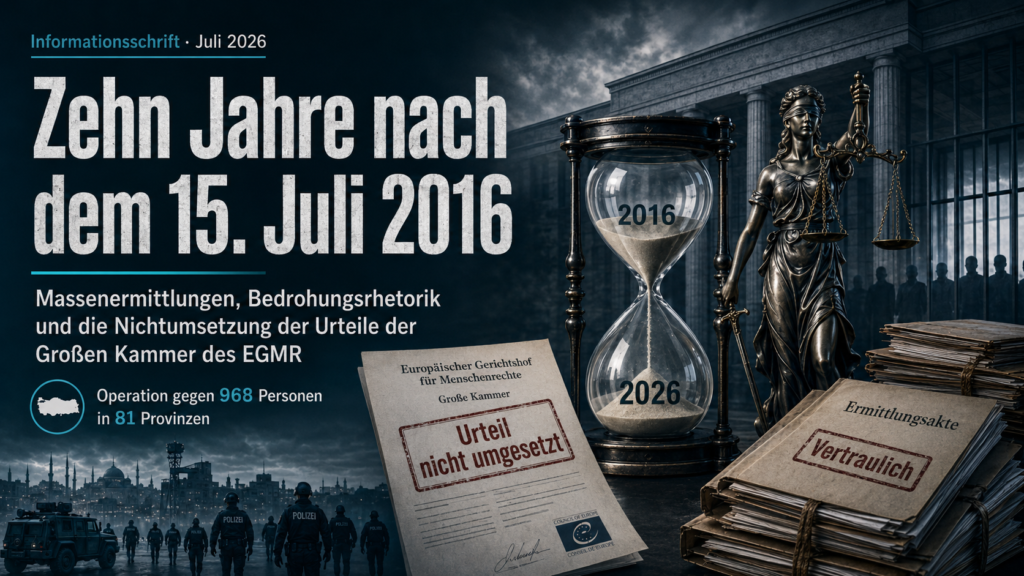
Human Rights
Defenders e.V.
Briefing Paper · July 2026
Human Rights and the Rule of Law
Ten Years After 15 July 2016
Persistent Threat Rhetoric, Mass Investigations and the Failure to Implement the Judgments of the Grand Chamber of the ECtHR
An assessment of the operation launched on 13 July 2026 against 968 people in 81 provinces of Turkey
Behrenstraße 29 · 10117 Berlin
The record in figures · Data announced by the Minister of Justice, 12 July 2026
Acquittals
Convictions
Pending proceedings
Approximately 69 per cent of all people subjected to proceedings were ultimately not convicted. Calculation and table in Annex 2.
About Human Rights Defenders e.V.
Human Rights Defenders e.V. (HRD) is a non-profit association dedicated to defending human rights and supporting persecuted people worldwide, with a particular focus on Turkey. HRD e.V. was founded in Germany by Turkish lawyers, former public officials and businesspeople who found political asylum in Germany and elsewhere in Europe.
HRD e.V. prepares reports on human rights violations and establishes contacts with other human rights NGOs and stakeholders, public authorities, and regional and international organisations. It provides legal advice to victims, initiates legal proceedings on their behalf, and prepares formal petitions and communications for the relevant United Nations bodies and European institutions.
Its aim is to help victims obtain justice through criminal law and human rights law. While criminal law addresses individual acts, human rights law also concerns the responsibility of the State. Most cases handled by HRD are first examined through criminal-law procedures at the national level. Where this proves insufficient, HRD turns to international bodies, such as the European Court of Human Rights or the competent organs of the United Nations. Where appropriate, HRD seeks to demonstrate that the State is unwilling or unable to investigate the offence in question and provide victims with truth and reparation.
Section 01Executive Summary
Ten years have passed since the attempted coup of 15 July 2016. The Turkish authorities state that the trials concerning the alleged direct participation of followers of the Gülen movement1 in the attempted coup have been completed. First-instance judgments have reportedly been delivered in 289 cases, bringing the legal “reckoning” over the coup attempt to an end. Yet the same authorities do not portray the movement as a threat that has diminished over time, but as a continuing danger to national security that can end only through collective surrender, “repentance” or “elimination” by the State.2
In line with this rhetoric, a nationwide operation targeting 968 suspects was launched on 13 July 2026, involving 81 chief public prosecutors’ offices, 81 provincial police departments and gendarmerie units. The operation was explicitly linked to the tenth anniversary of 15 July and announced in politically symbolic terms such as “cleansing campaign”, “survival of the State” and the “Century of Turkey”.3
In terms of scale, this is one of the largest judicial operations since the mass arrests during the 2016–2017 state of emergency and the 2019 operation targeting 1,112 people. Yet the published materials do not specify, for any of the 968 individuals, the alleged act, the evidence supporting the allegation or the required intent. Instead, the official statements rely on exceptionally broad categories such as “current structure”, “covert structure”, “hidden elements”, “new contact points”, finance, social groups and foreign connections.
This approach is fundamentally incompatible with the principles of legality, individual criminal responsibility and mens rea, as set out by the Grand Chamber of the European Court of Human Rights in its judgments in Yüksel Yalçınkaya and Şaban Yasak. The Grand Chamber made clear that, for a serious offence such as membership of an organisation, collective guilt and guilt by mere association are impermissible. Concrete evidence must establish that the individual knew of the organisation’s criminal nature, intended to join it and knowingly contributed to its criminal objectives.4,5
The figures published by the Minister of Justice likewise show that the scale of the new operation, in particular, requires critical scrutiny. The Minister stated that criminal proceedings had been initiated against 720,338 people since the coup attempt; no prosecution had been brought in 373,594 cases and 124,743 people had been acquitted. Together, these two categories comprise 498,337 people—approximately 69.2 per cent of all those subjected to proceedings. A system in which almost half a million people are ultimately not convicted should not be characterised as a “success”. From a human rights perspective, the low threshold for opening investigations, the resulting deprivation of liberty, loss of employment, subsequent stigmatisation and absence of effective remedies are matters of grave concern.6
The Turkish authorities must issue a public apology to those subjected to unfounded or unlawful proceedings. An effective mechanism must also be established to remedy losses relating to public office, professional status, pensions, social security, passports, property and reputation. Finally, the principles of individualised reasonable suspicion and rigorous judicial review must be upheld, since proceedings against a substantial proportion of the 968 people detained in the latest operation are likely eventually to be discontinued or to end in acquittal.
Section 02Purpose, Scope and Intended Audience of the Briefing Paper
The purpose of this briefing paper is to assess the operation of 13 July 2026 against approximately one thousand people not as an isolated criminal investigation, but in the context of a ten-year pattern encompassing mass investigations of members of the Gülen movement, official threat rhetoric and the implementation of the relevant judgments of the Grand Chamber of the European Court of Human Rights (ECtHR).
The latest development must be assessed from three perspectives:
- First: Why, and on what basis, is a continuing threat asserted when the coup trials have officially been declared complete?
- Second: Is there individualised reasonable suspicion and the required mens rea in respect of each of the 968 people?
- Third: Why have the hundreds of thousands of people whose cases were closed without prosecution or ended in acquittal still not been compensated?
The principal addressees of this document are the Committee of Ministers of the Council of Europe, the Council of Europe Commissioner for Human Rights, the German and Austrian members of the Parliamentary Assembly of the Council of Europe (PACE), the European Parliament and international human rights organisations.
This paper demonstrates that, even ten years after the coup attempt, lawful everyday, social, economic, professional and humanitarian activities in Turkey continue to be reinterpreted, through broad and unforeseeable categories, as grounds for suspicion of membership of a criminal organisation.
Section 03An Official Contradiction Ten Years On: The Claim That “the Reckoning Is Complete” and the Continuing Threat Rhetoric
3.1. Official declaration that the coup trials have been completed
The Minister of Justice stated that all 289 cases concerning direct participation in the coup attempt had been completed at first instance; 236 of the 271 cases that reached the Court of Cassation had been upheld and become final, thus bringing the “legal reckoning” to an end. The same statement also asserted that the alleged organisational backbone within the State had largely been dismantled.7
These statements necessarily imply that the criminal proceedings directly connected with the coup attempt are essentially complete and that, according to the official account, the alleged operational capacity within State institutions has been eliminated. Nevertheless, the new operation was presented not as an investigation into specific past acts, but as an open-ended “cleansing policy” to continue “until the last hidden member is removed”.
3.2. Maintaining the threat narrative through collective and political rather than legal criteria
In an interview on 2 July 2026, Foreign Minister Hakan Fidan linked the end of the security threat not to specific offences committed by individuals, but to declarations by the movement’s leadership—“repentance”, “regret”, a “request for forgiveness” or abandonment of an attitude directed against Turkey. Unless the movement dissolved or was otherwise “eliminated”, the matter would remain one of national security.8
This approach departs from the criminal-law criteria of individual conduct, culpability and proof. An individual’s criminal responsibility cannot be inferred from the political position of a large group, a public apology or a collective declaration of loyalty. Protecting national security is a legitimate duty of the State, but it cannot replace the requirement of individual criminal responsibility with a demand for collective submission.
The fundamental contradiction is clear: On the one hand, the State declares the coup trials and institutional purges complete; on the other, it reproduces the same threat to justify a “cleansing process” with no foreseeable end.
Section 04From Rhetoric to Operation
The days immediately preceding the operation can be divided into three phases.
Renewed declaration of a national-security threat
Hakan Fidan acknowledged that the movement had lost its former influence within public institutions. He nevertheless stressed that efforts at internal consolidation and cooperation with international actors continued. He said the organisational structures were now used primarily for “psychological operations”. Fidan expressly stated that the security authorities had to orient themselves according to this threat framework.
Definition of flexible threat categories
On 12 July, Minister of Justice Akın Gürlek described the movement as a “new-generation espionage network”. According to him, the network encompasses a “financial structure”, a “foreign structure”, “covert elements”, shell companies, business circles, various social groups and “new contact points” in everyday life.9
Nationwide operation against 968 people
The Minister of Justice announced that chief public prosecutors’ offices, together with the police and gendarmerie, had launched an operation against 968 suspects in all 81 provinces. Ankara, İzmir and Istanbul were identified as the provinces with the largest numbers of suspects, while investigations into “current structures”, “covert structures” and “affiliated elements” were said to be continuing in other provinces.10
The timing of the statements, the repetition of the same terminology and the incorporation of the operation into the tenth anniversary of 15 July indicate close coordination between judicial action and government communications.
Section 05Scale, Coordination and Symbolic Character
5.1. One of the largest simultaneously coordinated operations in recent years
The operation targeting 968 suspects is among the largest simultaneous measures since the arrest waves during the 2016–2017 state of emergency and the 2019 operation targeting 1,112 people. In 2017, arrest warrants were issued for 3,224 people; in 2019, 1,112 suspects were targeted across 76 provinces. In 2022, 543 of 704 people sought under warrants were detained, and in 2023, 611 people were detained in 77 provinces. In 2024, an operation targeting 544 people was announced against the “current structure”.11,12,13,14,15 The scale of the operation of 13 July 2026 exceeds the bounds of a routine investigation. (A comparative table is provided in Annex 1.)
5.2. Embedding judicial action in a political and symbolic framework
The official statement referred to the President’s leadership, a “major cleansing campaign”, the “survival of the State”, the “legacy of the martyrs” and the “Century of Turkey”. In this way, individual criminal investigations are transformed into components of a central State project and the tenth-anniversary commemorative campaign.
Investigations are announced with reference to the political leadership and an ideological vision of the State; this requires closer scrutiny of judicial independence and the presumption of innocence. The function of the judiciary is not to conduct a “cleansing campaign”, but to examine impartially the specific suspicion against each individual.
Section 06From Specific Offences to Flexible Categories: Legal Uncertainty and Collective Suspicion
6.1. The terms “covert element”, “current structure” and “new contact point”
Terms used in official statements—such as “covert element”, “current structure”, “new contact point”, “camouflage within a social group”, “financial channel” and “foreign structure”—do not constitute separate offences under the Turkish Criminal Code. They can form a basis for criminal investigations only if, in relation to a specific individual, they are connected to the objective and subjective elements of a concrete offence defined by law.
It is highly dangerous to classify ordinary relationships as camouflage and reinterpret lawful conduct—sharing a home, supporting a student, providing rent or maintenance assistance, professional solidarity, business relations, using social media, association activities or communicating with people abroad—as grounds for suspicion. Criminal suspicion and pre-trial detention must not follow merely from the existence of a social connection or rest on a generalised investigative logic. Concrete facts must show that the individual knew of the criminal purpose of the relationship and intentionally supported it.
6.2. The self-validating prosecution model
The logic of the official account leaves those concerned no way out: lawful acts can be interpreted as “camouflage”, while non-public conduct is treated as evidence that something is being “concealed”. Economic activity becomes a “cover”, social relationships become “contact points”, communication abroad becomes “cooperation with foreign actors”, and denial of the allegation becomes “lack of repentance”. Such a model replaces evidence-based individual responsibility with collective suspicion that can be neither verified nor disproved.
6.3. The allegation of an “espionage network” and the duty to substantiate it
The Minister of Justice described the group as a network of “political and military espionage”. Yet the published text contains no information identifying the foreign State or service for which those concerned allegedly acted. It remains unclear who allegedly obtained which State secret and how it was transmitted.16
Section 07Official Figures: Proceedings Against 720,338 People
7.1. What the figures announced by the Minister actually mean
The Minister of Justice stated that criminal proceedings had been initiated against 720,338 people since 2016. No prosecution was brought in 373,594 cases; 124,743 people were acquitted and 127,102 convicted. Proceedings against 83,404 people remain pending.17
The decisions not to prosecute and the acquittals together amount to 498,337 cases. This represents approximately 69 per cent of all people subjected to proceedings. Convictions account for about 17.6 per cent and pending proceedings for approximately 11.6 per cent. The calculation and table are set out in Annex 2.
7.2. Not a “success” in which to take pride
The Minister presents the number of acquittals as evidence of judicial diligence and proof that “the innocent are not punished together with the guilty”. Yet the fact that approximately half a million people underwent investigations or proceedings and were ultimately not convicted does not demonstrate judicial diligence. Rather, the figures raise questions as to whether the threshold of suspicion was too low from the outset, whether bulk lists were used and whether the criminal justice system became an instrument for society-wide screening. With a non-conviction rate of 69 per cent, the mass investigations cannot credibly be presented as a “success story”.
7.3. The human cost
A decision not to prosecute or an acquittal does not restore the lost years. Many of those affected experienced searches of their homes and workplaces, police custody and pre-trial detention, years of judicial-control measures, passport and travel restrictions, frozen assets, dismissal from public service, loss of employment in the private sector, professional bans, social stigmatisation and the breakdown of family ties. Children’s education and social lives, spouses’ livelihoods and the health of entire families were also harmed.
The Turkish authorities must disclose how many of the 498,337 people were detained or held in pre-trial detention, how many lost public office or their profession, how many were subjected to property or travel restrictions, how many received compensation and in how many cases entries in security databases were deleted. Without such disclosure, the official “record of the struggle” systematically conceals the human cost.
7.4. The State’s duty: apology, restoration of rights and effective compensation
Turkey must establish an independent, accessible and effective reparation programme for all those harmed by unfounded or unlawful measures. The programme must not be limited to individual compensation claims: the injustice caused by the widespread practice must be officially acknowledged and a public apology issued.
01Restoration of rights
Entitlements relating to public office, professional status, seniority, pensions, social security and education must be restored without delay.
02Correction of records
Stigmatising judicial, administrative, intelligence and risk-related records concerning people whose cases were closed without prosecution or ended in acquittal must be independently reviewed; entries lacking a legal basis must be deleted.
03Pecuniary and non-pecuniary compensation
A prompt and effective compensation mechanism must be created for deprivation of liberty, loss of employment and income, frozen assets, damage to health, interference with family life and reputational harm.
04Guarantee of non-repetition
Binding guidelines, training and oversight of decision-making practice must ensure that prosecutors and judges apply the Grand Chamber’s standards.
7.5. The renewed risk
The State’s own data show that a large proportion of those subjected to mass investigations are ultimately not convicted. The decisive question must therefore be asked now: in how many of the 968 cases will proceedings be discontinued or end in acquittal years later, after the individuals may already have lost their liberty, employment, family life, health or reputation?
This risk precludes waiting until the operation is complete before conducting a review. Safeguards—including individualised reasonable suspicion, proportionality, access to a lawyer, access to the case file and prompt judicial review—must operate from the first arrest warrant.
Section 08The Standards of the Grand Chamber of the ECtHR: Yalçınkaya and Yasak
8.1. Yüksel Yalçınkaya v. Türkiye
In its judgment in Yüksel Yalçınkaya, the Grand Chamber of the ECtHR held that treating the use of ByLock as automatically equivalent to membership of an organisation was incompatible with the guarantees of Article 7 ECHR against arbitrary prosecution, conviction and punishment. Under domestic law, the offence of membership of an organisation requires specific knowledge and intent, together with an organic link demonstrated by the continuity, diversity and intensity of activities. The Turkish courts had instead created an almost automatic presumption of guilt without examining the specific context, including the content of messages and the identities of communication partners.18
The Grand Chamber also found a violation of Article 6 ECHR because access to the ByLock evidence and the ability to challenge it effectively had been restricted. It further found a violation of Article 11 ECHR because membership of trade unions and associations had been used as incriminating evidence. Given the systemic nature of the problems, the Court expressly required Turkey to adopt general measures under Article 46 ECHR.19
8.2. Şaban Yasak v. Türkiye
In its Yasak judgment of 5 May 2026, the Grand Chamber reaffirmed that a conviction for a serious offence such as membership of an organisation must be based on individual criminal responsibility. Intent must be proved by concrete evidence concerning the nature of the relationship between the accused and the organisation; collective guilt and guilt by mere association are excluded.20
In the Court’s view, the applicant’s roles within the movement’s lawful and visible educational structures, before the national authorities classified the organisation as terrorist, were insufficient to establish that he knew of its terrorist character, intended to join it and actively and continuously contributed to its criminal objectives. The domestic courts’ failure to assess the individual’s intent, role and specific acts on a case-by-case basis amounted to a violation of Article 7 ECHR.21
8.3. Structural tensions in the light of the new operation
The official statement concerning the operation of 13 July 2026 relies on general categories such as “current”, “covert” and “affiliated” elements instead of identifying the specific acts alleged against each of the 968 people. The preceding official discourse had already treated social groups, economic activity, financial support, everyday contacts and foreign connections as general fields of suspicion. This approach is diametrically opposed to the examination required by Yalçınkaya and Yasak of individual knowledge, intent and conscious contribution.
Implementation of the Grand Chamber judgments is not limited to reviewing past convictions. New investigation and detention decisions must also be assessed against the same standards. Otherwise, the same pattern will be repeated against further individuals.
Section 09Key Issues Under the European Convention on Human Rights
9.1. Article 5 ECHR – Right to liberty and security
Police custody and pre-trial detention require reasonable suspicion based on facts capable of satisfying an objective observer, in the particular case, that the person may have committed an offence. Bulk lists, analyses of social networks or broadly defined categories of affiliation are not sufficient in themselves. It must therefore be established which concrete and individual facts support reasonable suspicion against each of the 968 people and whether the resulting deprivation of liberty is necessary and proportionate.
9.2. Article 6 §§ 1 and 2 ECHR – Fair trial and presumption of innocence
Suspects must have access to the case file and digital evidence, the opportunity to challenge the origin and integrity of the evidence, an independent review and the right to a reasoned decision. Terms such as “network of traitors”, “espionage network”, “cleansing of hidden elements” or “purification” risk portraying as guilty, in general terms, people who have not yet been tried by any court.
9.3. Article 7 ECHR – No punishment without law
The retrospective reinterpretation of lawful, neutral or everyday conduct as evidence of organisational membership can expand the objective and subjective elements of an offence in an unforeseeable manner. Administrative and intelligence categories such as “covert element”, “contact”, “financing” or “social group” cannot replace a criminal offence defined by law.
9.4. Articles 8, 10 and 11 ECHR – Respect for private life, freedom of expression and freedom of association
Interference with communications and network data, family and friendship ties, student house-sharing, mutual economic assistance, social-media activity, association work and professional solidarity is permissible only where lawful, necessary and proportionate. Branding human rights work abroad as “anti-Turkish” or a “psychological operation” creates a serious risk of restricting freedom of expression.
9.5. Article 18 ECHR – Limitation on the use of restrictions on rights
Although the evidence must be examined separately in each individual case, it must be determined whether restrictions on liberty and other rights pursue purposes other than the stated aim of criminal prosecution. Possible purposes include enforcing political loyalty, dismantling social solidarity or suppressing critical voices. The operation’s connection to the anniversary and its incorporation into a political vision of the State are factors warranting such examination.
Section 10The Presumption of Innocence, Stigmatising Language and Judicial Independence
Authorities may inform the public about counter-terrorism measures. Their statements must not, however, create the impression that people still under investigation are guilty, since criminal guilt cannot be predetermined before trial. Expressions such as “insidious octopus”, “network of traitors”, “mindless robots”, “espionage network”, “cleansing hidden elements” and “cleansing campaign” are dehumanising: they strip those concerned of their status as legal subjects and turn them into a social category to be “cleansed”.
Moreover, the actions of the chief public prosecutors’ offices, police and gendarmerie were announced in the name of the President’s leadership and political vision. Such language undermines confidence in the institutional independence of prosecutors and judges and creates a climate of pressure in which acquittals or decisions to discontinue proceedings may appear to be departures from State policy.
Section 11Failure to Implement the Grand Chamber Judgments and the Risk of Repetition
Under Article 46 ECHR, final judgments of the European Court of Human Rights are binding. In its Yalçınkaya judgment, the Court expressly held that the problems underlying the violation were systemic and that Turkey was therefore required to adopt general measures. Civil-society organisations may submit information on general and individual measures to the Committee of Ministers under Rule 9.2.
The new operation demonstrates that implementation of the judgments cannot be confined to past cases. The Turkish authorities must explain concretely how prosecutors and judges are trained, how intent is assessed in new proceedings, which safeguards prevent lawful activities from being used as incriminating evidence, by what standard mass digital and financial network analyses are converted into individualised reasonable suspicion, which procedures exist for reopening cases and deleting records, and which mechanisms ensure compensation and restoration of rights.
If these measures are not taken, the initiation of new mass proceedings under the label of the “current structure” will perpetuate, under new terminology, the patterns criticised by the Grand Chamber—automatic attribution of guilt and guilt by association.
Section 12Questions the Turkish Authorities Must Answer
- What specific offence is alleged against each of the 968 detained people, when was it allegedly committed, and what individual evidence exists?
- How many suspects are accused of conduct connected with violence, weapons, an attempted coup or coercion?
- How many people are being investigated solely because of social contacts, support for students, rent or maintenance payments, commercial activity, money transfers, social-media activity or foreign contacts?
- How were the standards on intent and individualisation developed in the Yalçınkaya and Yasak judgments applied before the arrest warrants were issued?
- What are the legal definitions and evidentiary standards for the terms “covert element”, “current structure” and “new contact point”?
- To which specific investigations, individuals, foreign States and transfers of information does the allegation of a “new-generation espionage network” relate?
- Was the timing of the operation chosen for investigative necessity, or was it administratively and communicatively coordinated with the tenth anniversary of 15 July?
- Do the 81 chief public prosecutors’ offices apply a uniform standard of reasonable suspicion and evidence?
- What data are maintained concerning the loss of liberty, employment, status, property and reputation suffered by the 498,337 of the 720,338 people whose cases were closed without prosecution or who were acquitted?
- What effective mechanisms exist for restoring rights, deleting records, issuing apologies and compensating those whose proceedings were discontinued or ended in acquittal?
Section 13Institutional Measures Required
13.1. Committee of Ministers of the Council of Europe
The Committee of Ministers should examine the implementation of the judgments in Yalçınkaya and Yasak systematically and in a coordinated manner, and request detailed information from Turkey on the evidentiary threshold, assessment of intent and use of lawful activities in the operation of 13 July.
13.2. Council of Europe Commissioner for Human Rights
The Commissioner should immediately engage with the Turkish authorities concerning the scale of the operation, stigmatising official language, access to lawyers, deprivation of liberty and remedies following discontinuation or acquittal. Where appropriate, the Commissioner should make a public statement and initiate systematic monitoring.
13.3. United Nations special procedures
The Special Rapporteur on the promotion and protection of human rights and fundamental freedoms while countering terrorism, the Special Rapporteur on the independence of judges and lawyers, the Special Rapporteur on freedom of opinion and expression, the Special Rapporteur on the rights to freedom of peaceful assembly and of association, and the Working Group on Arbitrary Detention should send a joint communication to Turkey and examine both individual cases and the broader patterns concerning the 968 people. Where there are specific indications of violations, the special procedures may issue urgent appeals or letters of allegation to States.
13.4. Institutions of the European Union
The European Commission and the European External Action Service should incorporate this issue into their political dialogue and rule-of-law monitoring concerning Turkey and seek information on implementation of the ECtHR judgments and the individual evidentiary basis for the operation against 968 people. The European Parliament should reiterate its demand for compliance with all ECtHR judgments, including implementation of the Yalçınkaya judgment.22
13.5. Human rights organisations
Human rights organisations should jointly monitor whether detainees have access to legal assistance, whether ill-treatment occurs, how health care is provided, the consequences for children and families, and the grounds and evidence on which detention is based. The suffering of those previously affected, who were acquitted or whose proceedings were discontinued, should be made as visible as the operation itself.
Section 14Conclusion
Ten years on, the question is no longer whether the trials of those directly involved in the coup attempt are continuing. The Turkish authorities themselves have stated that those proceedings are complete and that the alleged structures within the State have largely been eliminated. The fundamental problem today is the continual reproduction of the threat through a collective and deliberately vague national-security narrative, and the reinterpretation of ordinary social and economic relationships as allegedly criminal conduct under labels such as “covert elements”, “contact”, “financing”, “current structure” and “espionage”.
The operation of 13 July 2026 is among the largest mass judicial measures of recent years. An operation of this scale cannot serve as proof of success for an official commemorative campaign; it instead demands the strictest examination, for every individual, of reasonable suspicion, legality, intent, the presumption of innocence and proportionality.
The Minister of Justice’s own figures show that approximately half a million people were ultimately not convicted. These people are not a success statistic. The State must disclose how many lost their liberty, employment, health, property or reputation, and in how many cases family life was harmed. It must apologise to those wrongfully prosecuted, restore their rights and establish an effective reparation mechanism. To ensure that individuals are not vindicated only years later through discontinuation or acquittal, the Grand Chamber judgments in Yalçınkaya and Yasak must be applied from the very first day of the investigation.
Footnotes
- The Gülen movement, which is active in education and civil society, is classified as a terrorist organisation only in Turkey—for political reasons—and is referred to there as “FETÖ”. It is not recognised as a terrorist organisation in countries governed by the rule of law, nor by international institutions such as the United Nations, the European Union or the Council of Europe. ↩
- Sabah, “The latest scheme of the insidious octopus has been exposed! Minister of Justice Akın Gürlek speaks to SABAH: ‘It will continue until the last hidden member is eliminated’”, 12 July 2026, sabah.com.tr ↩
- Akın Gürlek, social-media post of 13 July 2026 and attached “press release”, x.com/abakingurlek ↩
- ECtHR (Grand Chamber), Yasak v. Türkiye, no. 17389/20, 5 May 2026, particularly §§ 200–213 on individual criminal responsibility, intent and the rejection of collective guilt; hudoc.echr.coe.int/eng?i=001-250157 ↩
- ECtHR (Grand Chamber), Yüksel Yalçınkaya v. Türkiye, no. 15669/20, 26 September 2023, particularly §§ 237–272 and 414–418; judgment and summary: hudoc.echr.coe.int/eng?i=001-227636 ↩
- Figures cited in the interview with Akın Gürlek of 12 July 2026: criminal proceedings initiated against 720,338 people; 373,594 decisions not to prosecute; 124,743 acquittals; 127,102 convictions; 83,404 pending proceedings. For the source, see footnote 2. ↩
- Sabah, interview with Akın Gürlek of 12 July 2026, section entitled “289 coup cases completed”; see footnote 2. ↩
- Ministry of Foreign Affairs of the Republic of Turkey, “Interview by Foreign Minister Hakan Fidan with CNN Türk, 2 July 2026”, relevant section, mfa.gov.tr ↩
- Sabah, interview with Akın Gürlek of 12 July 2026; sections entitled “New-generation espionage network” and “They are trying to establish new contact points”; see footnote 2. ↩
- Akın Gürlek’s post of 13 July 2026 and the attached press release; see footnote 3. ↩
- Sabah, “Operation against FETÖ’s current structure: 544 suspects detained”, 14 May 2024, sabah.com.tr ↩
- Anadolu Agency, “611 suspects detained in ‘Kıskaç’ operations against FETÖ in 77 provinces”, 24 October 2023, aa.com.tr ↩
- Anadolu Agency, “Minister Soylu: 543 suspects detained in the ‘Gazi Turgut Aslan’ operation against FETÖ”, 18 October 2022: 704 arrest warrants, 543 detentions, aa.com.tr ↩
- Anadolu Agency, “1,112 detention warrants issued in FETÖ investigations”, 12 February 2019, aa.com.tr ↩
- Anadolu Agency, “1,120 people detained in an operation against FETÖ’s covert structure in 81 provinces”, 26 April 2017: warrants were issued for 3,224 people; 1,120 people were detained in the first phase, aa.com.tr ↩
- Sabah, interview with Akın Gürlek of 12 July 2026, section concerning espionage allegations; see footnote 2. ↩
- Sabah, 12 July 2026, interview with Akın Gürlek, sections entitled “A careful assessment by the judiciary” and “The fight against FETÖ in figures”; see footnote 2. ↩
- ECtHR (Grand Chamber), Yüksel Yalçınkaya v. Türkiye, no. 15669/20, 26 September 2023; the Court held that the almost automatic presumption of guilt arising solely from the use of ByLock was incompatible with Article 7 ECHR. See the judgment, §§ 237–272, and ECtHR press release ECHR 267 (2023), hudoc.echr.coe.int (press release) ↩
- Yalçınkaya, findings under Articles 6, 11 and 46 ECHR; the Court held that the problems were systemic and that Turkey was required to adopt appropriate general measures. See the same judgment and press release. ↩
- ECtHR (Grand Chamber), Yasak v. Türkiye, no. 17389/20, 5 May 2026; the Court required intent to be established individually in convictions for membership of a terrorist organisation, excluding collective guilt or guilt by mere association. See ECtHR press release ECHR 114 (2026), hudoc.echr.coe.int (press release) ↩
- Yasak v. Türkiye, particularly concerning reliance on the applicant’s outwardly lawful educational activities, carried out before the organisation was classified as terrorist, as a basis for conviction without establishing the required intent; see §§ 200–213 of the judgment and the press release cited there. ↩
- European Parliament resolution of 10 February 2026 on the European Commission’s 2025 report on Turkey; calling on Turkey to implement fully the judgments of the European Court of Human Rights, including Yüksel Yalçınkaya and related cases, europarl.europa.eu ↩
Annex 1Comparative Table of Major Operations
| Date | Location / scope | People targeted | Arrested / detained | Target / note |
|---|---|---|---|---|
| 16 July 2016 | Denizli | 515 | — | On the night of the coup attempt and the following day: military personnel; direct intervention. |
| 16 July 2016 | General Staff / Ankara | 700 | — | Soldiers deployed during the coup attempt; direct intervention. |
| 16 July 2016 | Nationwide | 2,745 | — | Detention warrants issued for judges and prosecutors. |
| 11 August 2016 | Nationwide | 648 | — | Judges and prosecutors suspended from office. |
| 17 December 2016 | Primarily Istanbul | 530 | — | Structure within the Turkish Armed Forces; senior military personnel. |
| 26 April 2017 | 81 provinces | 3,224 | 1,120 (first phase) | Covert structure within the police. |
| 12 February 2019 | 76 provinces | 1,112 | — | 2010 entrance examination for deputy police commissioners. |
| 18 October 2022 | 59 provinces | 704 | 543 | Gazi Turgut Aslan; finances and current organisational structure. |
| 24 October 2023 | 77 provinces | — | 611 | “Kıskaç” operations. |
| 14 May 2024 | Multiple provinces | — | 544 | Current structure. |
| 15 July 2025 | 64 provinces | — | 306 | Measure announced on the anniversary. |
| 13 July 2026 | 81 provinces | 968 | Not known | Current or covert structure and affiliated elements; tenth anniversary. |
Annex 2Overall Figures and Percentage Breakdown Announced by the Minister of Justice
| Category | Number of people | Share | Explanation |
|---|---|---|---|
| Total criminal proceedings | 720,338 | 100% | Total announced by the Minister. |
| Decisions not to prosecute | 373,594 | 51.86% | The investigations were closed without prosecution. |
| Acquittals | 124,743 | 17.32% | No conviction at the conclusion of the proceedings. |
| Decisions not to prosecute and acquittals | 498,337 | 69.18% | Approximately half a million people. |
| Convictions | 127,102 | 17.64% | Number of convictions delivered. |
| Pending proceedings | 83,404 | 11.58% | Investigations or court proceedings remain pending. |
Note on the calculation: The percentages were calculated by dividing each category by the total of 720,338 and rounding to two decimal places. The official statement does not indicate whether the same person may be counted more than once in separate proceedings or precisely how the subcategories are composed.
Annex 3Source Documents and Links
- Ministry of Foreign Affairs of the Republic of Turkey, interview with Hakan Fidan on CNN Türk, 2 July 2026: mfa.gov.tr
- Sabah, interview with Minister of Justice Akın Gürlek, 12 July 2026: sabah.com.tr
- Statement by Akın Gürlek on the operation of 13 July 2026: x.com/abakingurlek
- ECtHR, Grand Chamber, Yüksel Yalçınkaya v. Türkiye, no. 15669/20, 26 September 2023: hudoc.echr.coe.int/eng?i=001-227636
- ECtHR, Grand Chamber, Yasak v. Türkiye, no. 17389/20, 5 May 2026: hudoc.echr.coe.int/eng?i=001-250157
- Council of Europe, information on civil-society communications under Rule 9: coe.int/en/web/execution/nhri-ngo
- AA, detention warrants for 2,745 judges and prosecutors, 16 July 2016: aa.com.tr
- AA, detention warrants for 3,224 people / 1,120 detentions, 26 April 2017: aa.com.tr
- AA, detention warrants for 1,112 people, 12 February 2019: aa.com.tr
- AA, “Gazi Turgut Aslan” operation, 18 October 2022: aa.com.tr
- AA, “Kıskaç” operation in which 611 people were detained in 77 provinces, 24 October 2023: aa.com.tr
- Sabah, operation against 544 suspects, 14 May 2024: sabah.com.tr
- AA, operation in 64 provinces in which 306 suspects were detained, 15 July 2025: aa.com.tr
- European Parliament resolution on Turkey, 10 February 2026: europarl.europa.eu
Behrenstraße 29 · 10117 Berlin
Briefing Paper · Ten Years After 15 July 2016 · July 2026
Prof. Dr. Hüseyin Demir
No comment yet, add your voice below!