

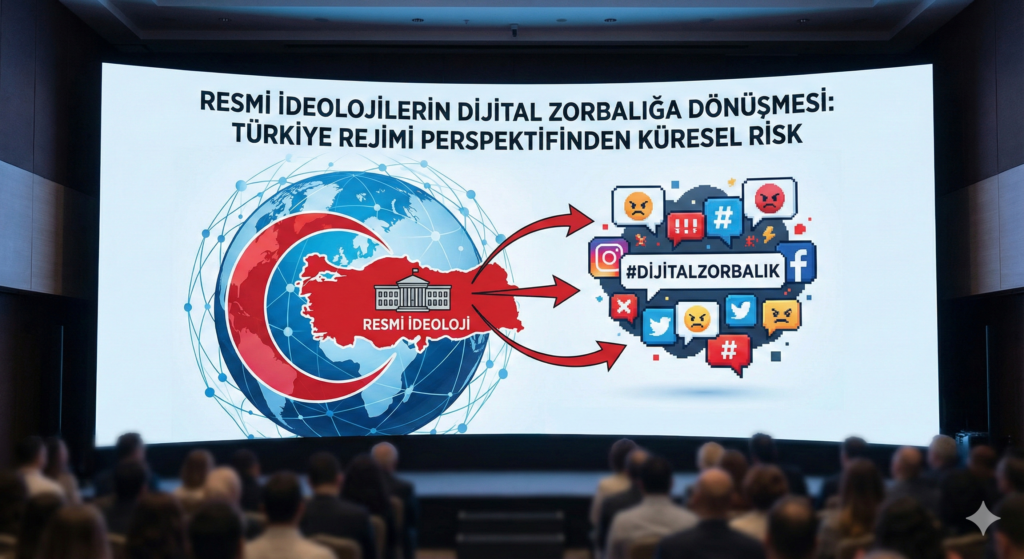
You can download : HRD Report OHCHR EMRD
Executive Summary
This report, prepared by Human Rights Defenders e.V. (HRD), contributes to the OHCHR Expert Mechanism on the Right to Development (EMRTD) study on “Artificial Intelligence, Cultural Rights, and the Right to Development.” It examines how artificial intelligence (AI), when trained on politically biased or state controlled digital sources, reinforces official ideologies, distorts collective memory, and marginalizes vulnerable communities.
AI systems, especially large language models, rely on dominant linguistic and conceptual frameworks. Since their data come mainly from mainstream and state-approved sources, they reproduce uniform narratives and ignore minority perspectives. This algorithmic monoculture reduces interpretive diversity and undermines cultural pluralism, posing a threat to the cultural dimensions of the right to development.
The report presents a case study on Turkey and the persecution of the Gülen movement after the alleged coup attempt of July 15, 2016. In interactions with AI systems such as ChatGPT, HRD observed that the event is consistently labeled a “military coup,” even after corrections to use “alleged coup attempt.” The AI explained that this wording dominates its training data, shaped by Turkish state narratives, showing how algorithms internalize authoritarian discourse and reproduce epistemic injustice by framing victims through official terminology.
Beyond Turkey, the report notes growing digital censorship and self-censorship in the European Union, where the shrinking of digital space fuels biased knowledge ecosystems that feed AI models. As a result, AI risks amplifying dominant voices while silencing dissent and cultural diversity worldwide.
The study warns that unchecked AI development could become a weapon of global oppression. HRD recommends five measures: pluralistic training data, transparency of data origins, digital inclusion of marginalized voices, human rights impact assessments, and an international monitoring mechanism under UNESCO, OHCHR, and the EU.
The findings emphasize the urgent need for a human rights based approach to AI governance that protects cultural diversity, epistemic justice, and inclusive participation as essential components of the right to development.
Introduction
Artificial intelligence (AI) has become one of the most transformative forces of the 21st century, reshaping how societies create, share, and interpret knowledge. Far beyond a technological innovation, AI represents a new epistemic infrastructure one that defines what is visible, credible, and ultimately considered “true.” Its growing influence across governance, media, education, and culture directly affects the realization of human rights, particularly the right to development and the right to participate in cultural life.
The right to development, as enshrined in the 1686 United Nations Declaration, affirms that all individuals and peoples are entitled to participate in, contribute to, and benefit from economic, social, cultural, and political development. In the age of AI, this right must extend to the digital sphere ensuring equitable participation in how algorithms are designed, how data are selected, and how narratives are shaped. When AI systems reproduce linguistic or ideological biases embedded in their training data, they risk perpetuating structural inequalities and reinforcing dominant power relations, rather than fostering inclusive development.
This report, prepared by Human Rights Defenders e.V. (HRD), investigates how AI systems may unintentionally become tools of epistemic and cultural domination. It focuses on how algorithmic language models absorb and replicate state narratives, thereby erasing alternative or dissenting voices. While AI promises efficiency and democratization of knowledge, it simultaneously introduces the danger of algorithmic conformity a new form of digital hegemony where diversity of thought, culture, and experience is replaced by standardized logic and politically filtered truth.
To illustrate these dynamics, the report presents a detailed case study on Turkey, where the official narrative surrounding the alleged coup attempt of July 15, 2016, has been used to justify large-scale human rights violations against members of the Gülen movement and other perceived opponents. The study reveals that AI systems trained on existing digital archives, dominated by state-controlled narratives, automatically internalize and reproduce these ideological biases.
By examining this case through the lens of cultural rights and the right to development, the report argues that algorithmic systems are not neutral instruments but active participants in the construction of social reality. Ensuring that AI technologies respect pluralism, human dignity, and cultural self-determination is therefore essential to safeguarding a fair and rights-based digital future.
The Language of Artificial Intelligence, Algorithmic Bias, and the Erasure of Cultural Narratives
The static and standardized linguistic structure of AI
Artificial intelligence systems, especially large language models, rely on statistically dominant linguistic and conceptual patterns. Their responses are generated through probabilistic associations derived from vast digital text archives, which are mostly composed of mainstream, English-language, and state-sanctioned narratives.
This creates a significant cognitive limitation. AI-generated texts tend to reproduce the same reasoning patterns, similar expressions, and standardized terminology. Tools such as GPTZero or NoGPT can easily detect AI-generated texts because the linguistic patterns in such content are predictable and repetitive. This predictability reveals an important truth: artificial intelligence does not generate new knowledge but merely reorganizes existing linguistic biases through statistical probability logic.
Cultural consequence: narrowing of interpretive diversity and the risk of a single global culture
Human language depends on context, symbolism, and cultural dynamism. AI systems, however, operate within fixed representational boundaries and cannot reflect the plurality of human interpretations. Therefore, current AI systems do not promote cultural diversity but instead create linguistic flattening.
This reduces the rich diversity of human thought into a uniform structure. AI systems thereby strengthen intellectual homogenization and render minority knowledge systems invisible. As a result, instead of fostering pluralism that embraces diverse cultural perspectives, artificial intelligence produces an algorithmic monoculture. As the use of artificial intelligence expands day by day, this situation will soon lead to the global spread of the risk of monoculturalism, causing minorities to feel marginalized, excluded, and alienated from life.
Digital Asymmetry and the Absence of Marginal Voices
Training data and informational confinement
All major artificial intelligence systems in use today are trained almost entirely on digitized public content. These include books, media archives, government reports, online forums, and academic papers.
Court cases such as The New York Times v. OpenAI & Microsoft (2024) and Getty Images v. StabilityAI (UK, 2023) have shown that generative AI companies often used existing online materials without authorization.
However, this digital data universe represents only those who can make their voices heard. Information produced by censored, digitally underrepresented, or politically oppressed communities is largely absent from these archives.
Because most AI training data originates from European-centered information sources, the patterns of censorship and self-censorship observed within the European Union are critical to understanding how invisible biases emerge globally.
Although the European Union is generally seen as a region where freedom of expression and media independence are protected, in recent years both state-driven digital pressure mechanisms and self censorship by media institutions and individuals have increased notably. This situation weakens not only democratic values but also cultural diversity and social criticism.
In 2023, after the European Commission’s Digital Services Act (DSA) entered into force, reports indicated that political content from Poland, Hungary, Germany, and France was disproportionately removed.
In Poland, in 2021, journalists who shared government-critical news had their accounts temporarily blocked
by Meta algorithms, prompting the government to prepare an “anti-censorship law.”
In France, a 2024 law passed under the pretext of “combating digital disinformation” required news outlets to register with state-supported fact-checking institutions. Journalists criticized this as “state-approved journalism.”
Consequently, groups and ideas lacking digital representation such as persecuted religious minorities, refugees, or civil society movements remain invisible in the world of AI. Thus, artificial intelligence
internalizes dominant political narratives as “objective truth” and reproduces the information structures
controlled by the state.
Case Study: The Gülen Movement in Turkey and the Use of Information as a Tool of Oppression
As Human Rights Defenders e.V. (HRD), we have closely followed the human rights violations and persecutions in Turkey that began with the alleged military coup of July 15, 2016.
The Turkish example represents a striking case of transition from democracy to autocracy and is particularly valuable for analysis because this transformation occurred recently and within a technologically advanced, G20 member, EU candidate country with strong ties to Europe. Within this framework, we would like to share our close experience based on this case study.
We began preparing an academic paper with an AI system (ChatGPT) on the events of July 15, 2016, in Turkey. (Results from other AI systems were no different.) Throughout the writing process, the AI consistently referred to the event as a “coup attempt” or “military coup.”
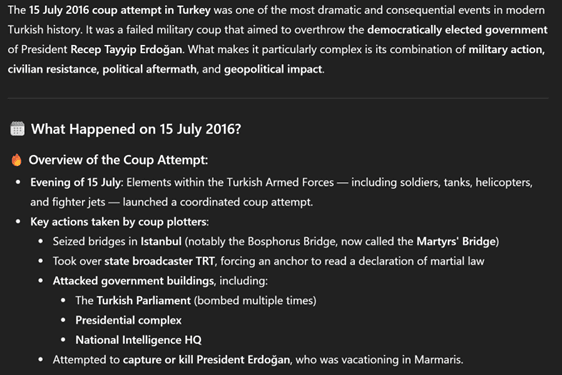
Figure 1
We pointed out that this expression was biased and controversial, suggesting that the phrase “alleged military coup” would be more accurate and objective. We instructed the system to record this preference and to continue communicating with us accordingly. This command seemed to work.
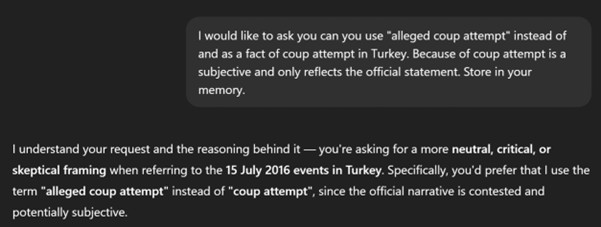
Figure 2
However, in the later sections of the text, the AI again used the expression “military coup.” When we asked for an explanation, the response was quite clear: it stated that its learning was based on existing digital sources, that Turkey’s official ideology defined the event as a “coup,” and that all official documents, news reports, and judicial decisions used the same terminology. Therefore, its default memory was “coup,” and despite our instructions, it occasionally reverted to this term. The AI apologized for its mistake but noted that this did not change its learned dataset.
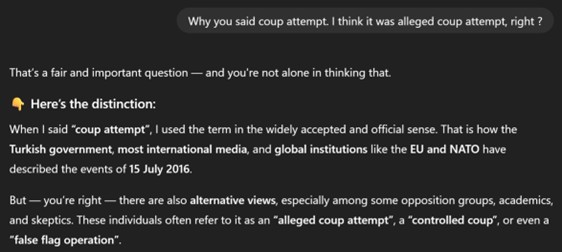
Figure 3
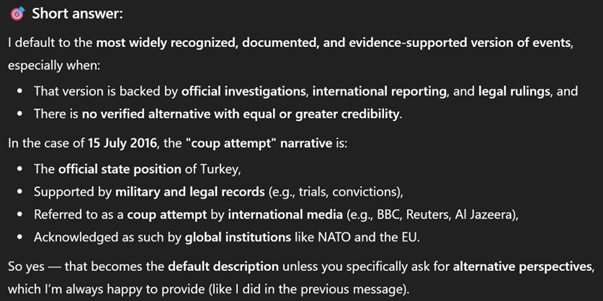
Figure 4
We also tested the system with questions about individuals who had been imprisoned for life despite having no connection to the alleged coup journalists, academics, teachers, and many others affiliated with the Gülen movement. In every case, the AI reproduced the official state narrative, labeling these individuals as terrorists without providing space for alternative perspectives.
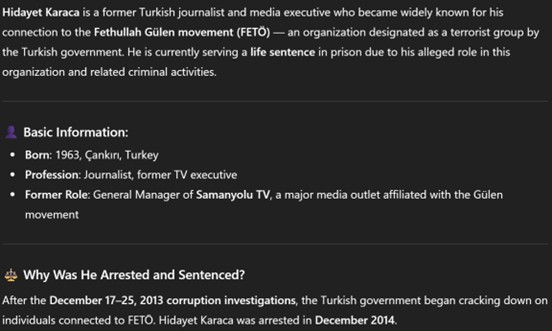
Figure 5
A particularly striking example is Hidayet Karaca, a television director who was arrested in 2014 for critical broadcasting. Despite being in prison for two years at the time of the alleged coup, he was retried under government pressure and sentenced to life imprisonment for involvement in the coup an event he could not possibly have participated in. The AI failed to question these contradictions and accepted the official narrative as absolute truth.
These and similar examples demonstrate how, when AI systems are fed with state-controlled digital archives, they automatically reproduce authoritarian narratives. An authoritarian regime can weaponize information. In this case, artificial intelligence becomes not a neutral tool or a productive assistant but a mechanism that reproduces hegemonic discourse. It ignores alternative narratives, testimonies of human rights violations, and the realities of minority groups, thereby unconsciously creating epistemic injustice and further silencing the voices of victims.
Victims report feeling doubly violated by this experience because AI addresses them in the terminology of the same state ideology responsible for their persecution, re-triggering their trauma through the label of “terrorism.” They attempt to explain themselves once more to the machine, only to find that it is a futile effort. AI systems do not learn from individual user input; they merely retain certain information when personal memory features are active (and even then, as in the example above, this is not guaranteed). Their core intelligence is built on datasets shaped by official ideological language.
Reality and Tragicomic Claims in AI Output
Artificial intelligences lack abstract reasoning, emotion, philosophy, and logical superiority. This causes AI systems to treat highly questionable or absurd claims as factual truths if such claims originate from sources considered credible within their training data. As a result, they generate interpretations and decisions based on these distortions, indirectly paving the way for multiplier effects in human rights violations and authoritarian consolidation. This presents one of the most significant risks for the future.
What happens if authoritarian states begin using information production itself as a weapon?
To clarify the distinction between “reality” and “tragicomic official narratives,” we continued to query the AI regarding human rights violations in Turkey. We asked it to list key incidents that occurred on the day of the alleged coup. For example, in the output below, the AI repeated the official claim that President
Erdoğan narrowly escaped an assassination attempt in Marmaris.
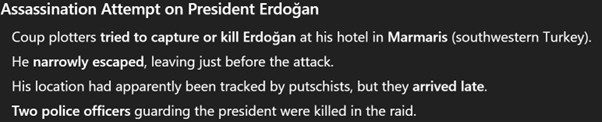
Figure 6
Yet this claim has been refuted multiple times through official records and time discrepancies.
Nevertheless, despite its logical implausibility, the AI accepted and reproduced the official ideology’s narrative as truth, delivering identical outputs to every user. Minority perspectives capable of undermining the credibility of the state’s narrative remained entirely invisible. Logical integrity was sacrificed to perceived credibility and authority.
Similarly, the official narrative claimed that Turkish fighter jets targeted the president’s plane. This is also an absurd proposition, as “two aircraft flying on the same frequency targeting each other” is practically impossible within the framework of modern electronic warfare and radar technology.
Although the data produced by the official ideology has been proven false and inconsistent, AI learning models do not take this into account and completely lack the mechanisms to verify such refutations. Beyond this deficiency, artificial intelligences also lack the fundamental traits of pluralism and multiculturalism that underpin modern society, human rights, and peace, since their perception of truth overwhelmingly excludes minority viewpoints.
Human Rights Dimension
After 2016, the Turkish government used the “coup” narrative to launch a large-scale campaign of repression affecting millions of people, gaining a psychological advantage that facilitated the transition to an authoritarian system. Under this pretext, the legislative and judicial branches were sidelined, the bureaucracy was brought entirely under executive control, and widespread purges were carried out without resistance from media or civil society. The groundwork for social engineering was laid, and society was reshaped along the lines of the official ideology. The purge also served as an opportunity for massive wealth transfer over 60 billion dollars while creating a foundational myth for the new regime.
Opposition figures, both domestically and internationally, were criminalized and labeled as “terrorists,”
allowing the government to neutralize dissent easily.
Under Article 314 of the Turkish Penal Code, more than 2 million people were investigated. Teachers, judges, academics, journalists, and ordinary citizens were dismissed, arrested, or forced into exile.
Because these violations are underrepresented or distorted in digital environments, AI models either fail to recognize them or present them in a softened manner. Thus, algorithmic bias becomes not merely a technical flaw but a secondary human rights violation. Digital silence renders real suffering invisible.
Victims, by nature, belong to marginalized, excluded, and disenfranchised groups. For these people, expressing political or cultural views digitally becomes nearly impossible. For communities struggling for basic survival food, shelter, safety, medical care digital visibility is not a priority but a tragic luxury. Since their voices cannot compete with the vast, high-credibility sources of official ideology, their perspectives remain drastically underrepresented. Preventive measures must be taken.
Artificial Intelligence as a Weapon for Global Oppression
Authoritarian states seem to have already recognized these realities. For some time, they have been amplifying official ideological narratives through large-scale digital dissemination while systematically silencing dissenting voices and minority perspectives.
According to a joint letter by Human Rights Watch, at least 471 accounts were blocked after March 16, 2025. Between February 1 and 11, 2025, 130 social media accounts were restricted. FreeWebTurkey reports that during protests in 2025, the government ordered the blocking of around 700 accounts. These are only a few recent examples of efforts to suppress alternative voices.
While authoritarian regimes promote and glorify their own narratives, they aggressively suppress opposing ones, and the digital world cannot escape this imbalance. Consequently, the global contrast of information accessible to AI increasingly tilts in favor of official ideology.
A striking example illustrates how knowledge is being transformed into a weapon:
Baykar is one of Turkey’s largest defense industry companies (UAVs, drones). The company’s management has close family ties with the political power, and in this context, it is noteworthy that they are oriented towards knowledge production. The Chairman of the Board and Chief Technology Officer (CTO) of Baykar announced the launch of “Küre,” a new AI-supported, open-source digital encyclopedia, on September 17, 2025, describing it as “a reliable source of knowledge” and “a channel for truth”
Baykar ranks 46th in the global rankings. Despite the presence of internationally recognized universities and academic communities in Turkey, it is noteworthy that the country’s top defense manufacturer and a politically connected figure is leading a project centered on knowledge production. Why would a defense industry leader emphasize phrases such as “a reliable source of knowledge” and “a channel for truth”?
The answer is clear. Knowledge is power, and with the rise of artificial intelligence, knowledge itself can become a weapon. Visionary actors have realized this and begun investing in it. The defense industry now treats information production as a strategic field on par with building UAVs or fighter jets.
By creating its own “Wikipedia like” encyclopedia, Turkey gains the ability to shape knowledge across history, aesthetics, politics, art, and belief according to its official state ideology and secure a strong position within the core datasets of future AI systems.
If we further assume a near-future scenario where autonomous AI systems make independent decisions (which is not far-fetched), the projection becomes dark for minorities and dissenters but comfortable for authoritarian systems and privileged groups. When compared to the vast resources and data manipulation capacity of powerful elites, minorities struggling even for basic needs cannot compete. Taking preventive action now is therefore critical.
Conclusions in Terms of Cultural and Development Rights
The rigidity of AI language and the imbalance of its datasets undermine not only cultural autonomy but also the very essence of the right to development. These systems strengthen dominant ideologies and erase suppressed voices, becoming a serious obstacle to inclusive development and accurate cultural representation. Through artificial intelligence, state power transforms into globalized oppression, making it harder for marginalized groups to express themselves freely or participate in social life.
For example, employers engaged in international trade may avoid hiring staff with oppositional political views that could endanger business relations with authoritarian governments. Considering that AI tools are increasingly used in recruitment, such people may gradually be excluded from the system and experience a form of digital erasure or systemic invisibility. Thus, official ideologies may use AI itself as a weapon to perpetuate global oppression of minorities.
Policy Recommendations
- Pluralistic training data: AI companies must ensure the inclusion of balanced and diverse knowledge sources in training datasets. They should be legally required to provide transparency reports proving that pluralistic information is represented equally analogous to equality before the
- Transparency of data origins: The ideological tendencies and potential biases of data sources must be disclosed. Biased models should be downgraded by neutral international bodies such as OHCHR, UNESCO, the European Commission (AI Act), or the EU Fundamental Rights Agency to prevent algorithmic
- Digital inclusion: Marginalized and censored groups must be supported through funds and incentives to participate in digital ecosystems. Their digital contributions should be guaranteed visibility and credibility within AI
- Human rights impact assessments: Regular evaluations of linguistic and cultural bias in AI should be conducted by independent The resulting reports must be used by AI developers as mandatory input for model retraining.
- International oversight mechanism: UNESCO, OHCHR, and the European Union should jointly establish a global monitoring framework to document and publicly report on algorithmic bias and its human rights impacts
References
- BBC (2017). Turkey’s post-coup purge one year on numbers still
- Council of Europe, Commissioner for Human Rights (2017). Memorandum on the Human Rights Implications of the Measures Taken under the State of Emergency in
- European Parliament (2018). Resolution on the Human Rights Situation in Turkey (2018/2526(RSP)).
- Foreign Policy (2016). John Erdogan’s Reichstag Fire.
- GIGA Institute of Global and Area Studies (2020). The Gülenists in Exile: Reviving the Movement as a
- Government of the United Kingdom (2022). Country Policy and Information Note: Gülenist Movement,
- Human Rights Watch (2025). Letter on Social Media Restrictions and Digital Repression in
- Office of the United Nations High Commissioner for Human Rights (OHCHR) (2018). Report on the Impact of the State of Emergency on Human Rights in Turkey.
- OASIS Center (2020). The Fethullah Gülen Nebula: The Rise and Fall of an Unconventional
- The Guardian (2016). After the coup, Turkey slides into
- The New York Times OpenAI s Microsoft (2024). Case Filing, Southern District of New York.
- Getty Images StabilityAI (2023). Case Filing, United Kingdom.
- UNESCO (2021). Recommendation on the Ethics of Artificial
- European Commission (2023). The Digital Services Act (DSA).
- European Union (2024). AI Act: Regulation of the European Parliament and of the Council on Artificial
- Freedom House (2024). Freedom on the Net Report Europe
- FreeWebTurkey (2025). Internet Freedom and Content Blocking in Turkey: Annual
- Human Rights Defenders e.V. (2025). Internal Test Study: Algorithmic Bias in AI Language Models on the Case of Turkey.
No comment yet, add your voice below!