

Guest Contribution · Ten Years After July 15, 2016
The State of Emergency
That Shall Not End
Ten years ago, a coup attempt failed in Turkey. Its defense became the justification for a restructuring of the state that continues to this day: mass dismissals via name lists, a purged judiciary, criminal convictions without proof of individual guilt. The European Court of Human Rights has measured the mechanics of this decade in four binding judgments. To this day, they have not been enforced. Europe has taken note of this and has barely acted. On the tenth anniversary, it is time to draw consequences.
By Prof. Dr. Hüseyin Demir, Chairman of World Human Rights Defenders e. V.
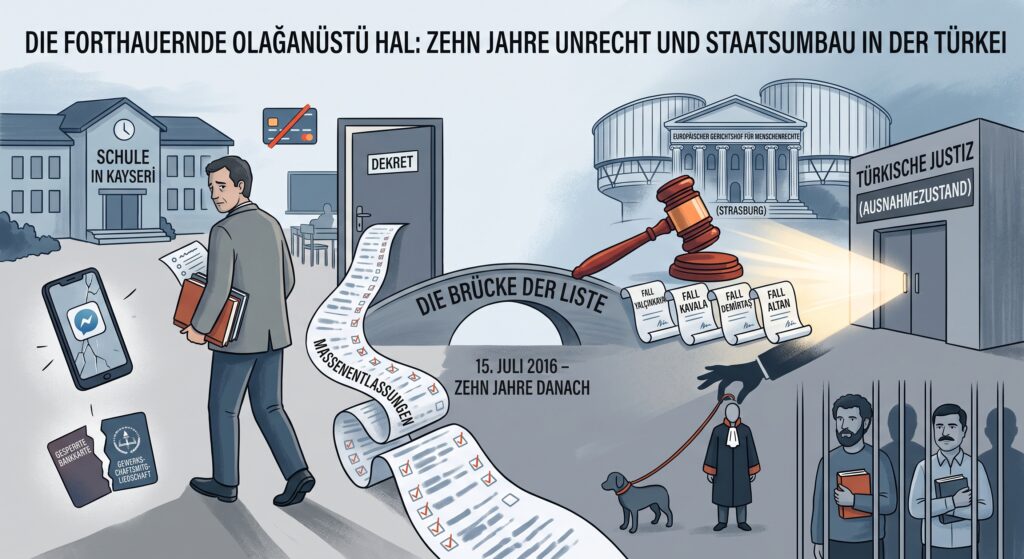
Yüksel Yalçınkaya was a teacher in Kayseri, a pious industrial city in the Anatolian highlands. In the autumn of 2016, he lost his job by decree. His name was on a list appended to an emergency decree; no court had ever seen a piece of evidence against him. A year later, the judiciary delivered the verdict that the list had anticipated: six years and three months in prison for membership in a armed terrorist organization. The evidence: an encrypted messenger app on his phone, an account at a specific bank, membership in a trade union. None of this was punishable when he did it. The Turkish authorities attribute the app, ByLock, to the movement of the preacher Fethullah Gülen, whom Ankara considers the mastermind behind the coup attempt; the correctness of this attribution did not matter in the subsequent human rights proceedings.
In September 2023, the Grand Chamber of the European Court of Human Rights declared this judgment incompatible with one of the oldest principles of criminal law: no punishment without law. Article 7 of the Human Rights Convention guarantees this principle, and its purpose is protection against arbitrary prosecution, conviction, and punishment. The Court found exactly this protection to be violated: the Turkish courts had almost automatically evaluated the mere use of the app as evidence of terrorist membership, without examining the knowledge and intent of the accused in the individual case. Such an expansive and unforeseeable interpretation of the criminal law, according to the Grand Chamber, equates to a presumption of guilt and effectively invalidates intent as an element of the offense (Yüksel Yalçınkaya v. Turkey, §§ 259–272). The Court also recalled that Article 7 is non-derogable in times of emergency: a state may not deviate from it even if the life of the nation is threatened. Around 8,500 similar complaints were already pending in Strasbourg at that time.
The teacher’s case is not an isolated incident, but a building block of a system: the coup attempt of July 15, 2016, took place on the streets and was defeated there. Its defeat, however, provided the rationale with which the constitutional order was permanently restructured. And Europe is not a spectator in this finding, but a participant.
The night itself weighs heavily. A faction of the armed forces attempted to seize power. Tanks deployed in Ankara, the parliament was bombed for the first time in its history, and according to official figures, more than 250 people died. The Court has never disputed the seriousness of this situation. On July 21, 2016, Turkey notified under Article 15 of the Convention that it would derogate from certain guarantees, and the Court recognized that the life of the nation was threatened. What it rejected in one judgment after another was the conclusion that an attack on the constitutional order allowed its indefinite suspension. For Article 15 permits emergency measures only to the extent strictly required by the exigencies of the situation. It is a narrowly tailored exception, not a general power of attorney. The Turkish leadership read it the other way around.
What followed was a “purge” at all levels. The state of emergency, initially limited to three months, was extended seven times; governance was conducted by decree, for a long time without effective judicial review. The UN Human Rights Office counted more than 150,000 dismissed or suspended public servants, well over 100,000 of whom were removed by name via lists: without charges, without a hearing, without individual justification. The dismissal amounted to a civil death. Passports were confiscated, pension entitlements cancelled, and the stigma made even employment in the private sector virtually impossible. The judiciary was hit first: more than 4,000 judges and prosecutors lost their offices, including two constitutional judges. One of them, Alparslan Altan, was detained without a legal basis, as the Court established in 2019. The Venice Commission of the Council of Europe identified the pattern early on: collective dismissals without individual examination. Even legal protection became part of the design. The specially created inquiry commission, which the Court classified as a remedy to be exhausted first, approved only about one in seven of the approximately 127,000 decided applications.
Then there are the cases that had nothing to do with the coup. The publisher and philanthropist Osman Kavala has been in prison since October 2017. The Court found in 2019 that his detention in reality served the purpose of silencing him and deterring other human rights defenders. The Court makes such a finding under Article 18 of the Convention, which prohibits the misuse of permissible restrictions for ulterior motives, only in the gravest cases. In February 2020, Kavala was acquitted and re-arrested on the very same day before he could leave the prison. The Committee of Ministers of the Council of Europe subsequently initiated the second infringement procedure in the history of the Convention. The judgment remains unenforced to this day; in March 2026, the Grand Chamber deliberated on a further complaint by Kavala. The opposition politician Selahattin Demirtaş has been detained since November 2016. From his cell, he campaigned for the presidency via video message in 2018 and wrote short stories that became bestsellers. The Grand Chamber established in 2020 that his continued detention was primarily aimed at stifling pluralism and limiting the freedom of political debate — and thus at what constitutes the core of a democratic society (Selahattin Demirtaş v. Turkey No. 2, § 437). This changed nothing: in January 2026, a Turkish court sentenced him to a further seventeen months in prison, this time for insulting the president. Locking away a promoter of civil society and a leading opposition politician sends the same message twice: the target of discipline is not only the state apparatus, but also the society that could control it.
Above all, however, the exception was made permanent.
In April 2017, in the midst of the state of emergency and under severely restricted public debate, a narrow majority voted for the introduction of the presidential system. Opposition media were shut down, political competition was distorted. Since then, the Council of Judges and Prosecutors, which decides on appointments, promotions, and disciplinary proceedings in the judiciary, has been tied to the president and his parliamentary majority. The Venice Commission warned even then of a slide into a regime of personal rule.
In 2018, the state of emergency formally ended. Yet, with Law No. 7145, central emergency instruments were transferred into ordinary law: extended police custody, continuing dismissal powers, far-reaching restrictions on the freedom of assembly. The exception was not abolished; it was naturalized.
Meanwhile, defiance is no longer directed only against European judgments, but against the country’s own courts. When the Turkish Constitutional Court ordered the release of the lawyer Can Atalay, who had been elected to parliament from prison, the competent criminal court refused to implement it. The Court of Cassation filed a criminal complaint against the constitutional judges, and parliament stripped Atalay of his mandate.
A state whose courts defy its own constitutional court no longer even pretends internally that law binds power.
Why does this concern Europe? For three reasons, and none of them have to do with charity. First: Turkey has been a member of the Council of Europe since 1949 and is legally bound by every judgment of the Court. Every unenforced judgment — the Kavala judgment is the most visible — teaches all 46 member states that this binding nature is negotiable. The Convention system is not an internal Turkish affair, but the common legal order of the continent. And it erodes where its disregard remains without consequences. Second: The consequences have long since arrived here. Germany alone has granted protection to thousands of Turkish nationals since 2016, among them judges, diplomats, and officers of the very state that once employed them. Third: Turkey is a negotiating partner of the European Union, on migration, the customs union, and security. Anyone who negotiates without putting the question of the rule of law on the table has already answered it.
What then is to be done? Three steps, all within existing law. The Committee of Ministers should pursue the enforcement of the Kavala judgment with the same persistence with which it initiated the procedure under Article 46 paragraph 4 of the Convention; interim resolutions are not an end point, but tools. The member states should make the general measures required in the Yalçınkaya judgment, i.e., the correction of thousands of similar convictions, a fixed point on every bilateral agenda with Ankara. And German authorities and courts should draw the consequence that the judgment already dictates to them: a conviction based solely on the use of an app, a bank account, or a membership does not prove a criminal offense. Rather, according to the findings of the Court, it is itself the violation of the law. This applies to asylum procedures just as it does to extradition requests. None of this is radical. It is the mere application of judgments that have long since been rendered.
Yüksel Yalçınkaya has served his sentence. Today, his name stands over a judgment that in principle reaches thousands — and in reality meets courts that continue to be occupied and supervised by the bodies of the emergency state. Somewhere in Kayseri, there is a classroom from which a list removed him before any judge had ever heard his name. The tanks were stopped before morning. The lists and decrees of that time live on. Reversing them is not a Turkish task alone. It is a European one.
No comment yet, add your voice below!